
Some years ago, Prof. Stefan Williams, from the University of Sydney’s marine robotics program
The Offspring
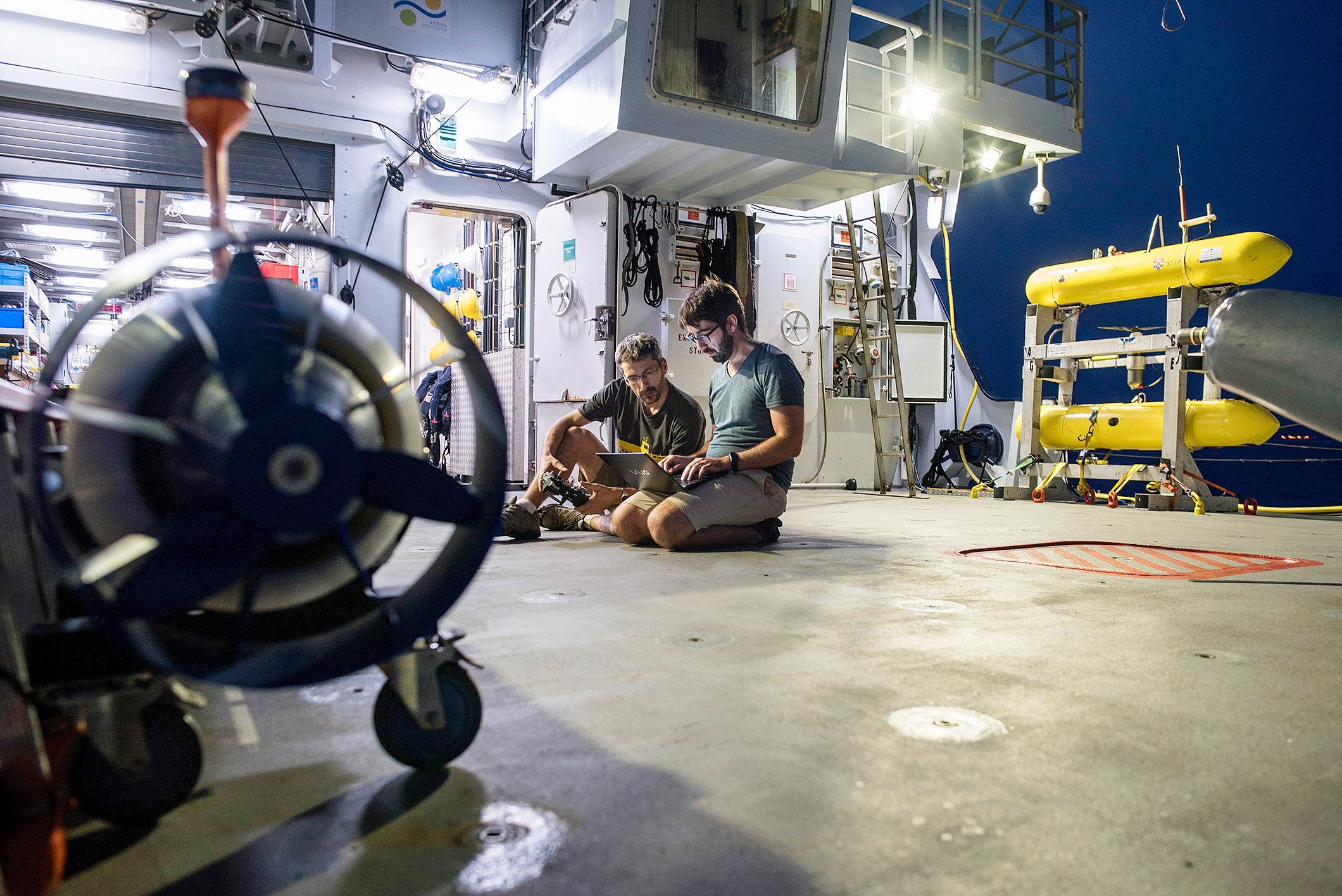
For the Coordinated Robotics expedition, the Australian team has packed a serious amount of gear and technology. The different robots they have brought with them are all capable of acquiring roughly the same kind of data, but there are several factors that make each one unique and suited to perform better in different work conditions.
Autonomous Underwater Vehicle (AUV) Sirius
The Babysitter
A big part of the University of Sydney's team has been developing navigation systems for these various platforms. Today, those capabilities are fairly mature, so the experts are focusing now on the ability for vehicles to communicate with each other underwater and improve their navigation estimates by exchanging information. One exciting addition is the surface vessel.
The surface vessel is a catamaran with an acoustic array that can compute the distance and position of all the underwater vehicles beneath it. It will be designed to track and communicate with the underwater vehicles while they are underway. “We’d like to demonstrate how to keep track of the vehicles and replan their missions if necessary, but from a vessel that is autonomous,” explains Dr. Oscar Pizarro, Chief Scientist, “which opens the possibility of freeing a ship like Falkor to do other tasks while these vehicles are working. This way, monitoring the progress of the mission doesn’t tie an expensive ship full of humans to just babysit these robots.”
Prof. Stefan explains how the integration between each underwater vehicle and the surface vessel would run: “We program the underwater vehicle after looking at bathymetric charts to decide which areas we want to survey. We then program a mission, and get the vehicle to go down - "mowing the lawn" by navigating back and forth. It might spend a little more time on one feature and then move to another, with the surface vessel would following along, keeping track of its progress and status.”
There are surface vessels capable of very long-range deployment and that can take advantage of the sun or wave energy to make them very energy-efficient. In Prof. Williams’ opinion, combining those capabilities with the possibility of deploying and recovering underwater vehicles could change the way researchers perform ocean science.
Huge amounts of time and effort have been invested in developing these robots, and the road ahead is still very long. Dr. Oscar Pizarro, however, has no doubt that the work is worth it: “There are several reasons. From the point of view of our society, understanding how the oceans work and what is happening to them is critical. We take them for granted, but oceans really support life on Earth in many ways. To understand how to manage them and arrive responsible, cost-effective decisions, that will ultimately keep us alive depends on understanding the oceans.”