



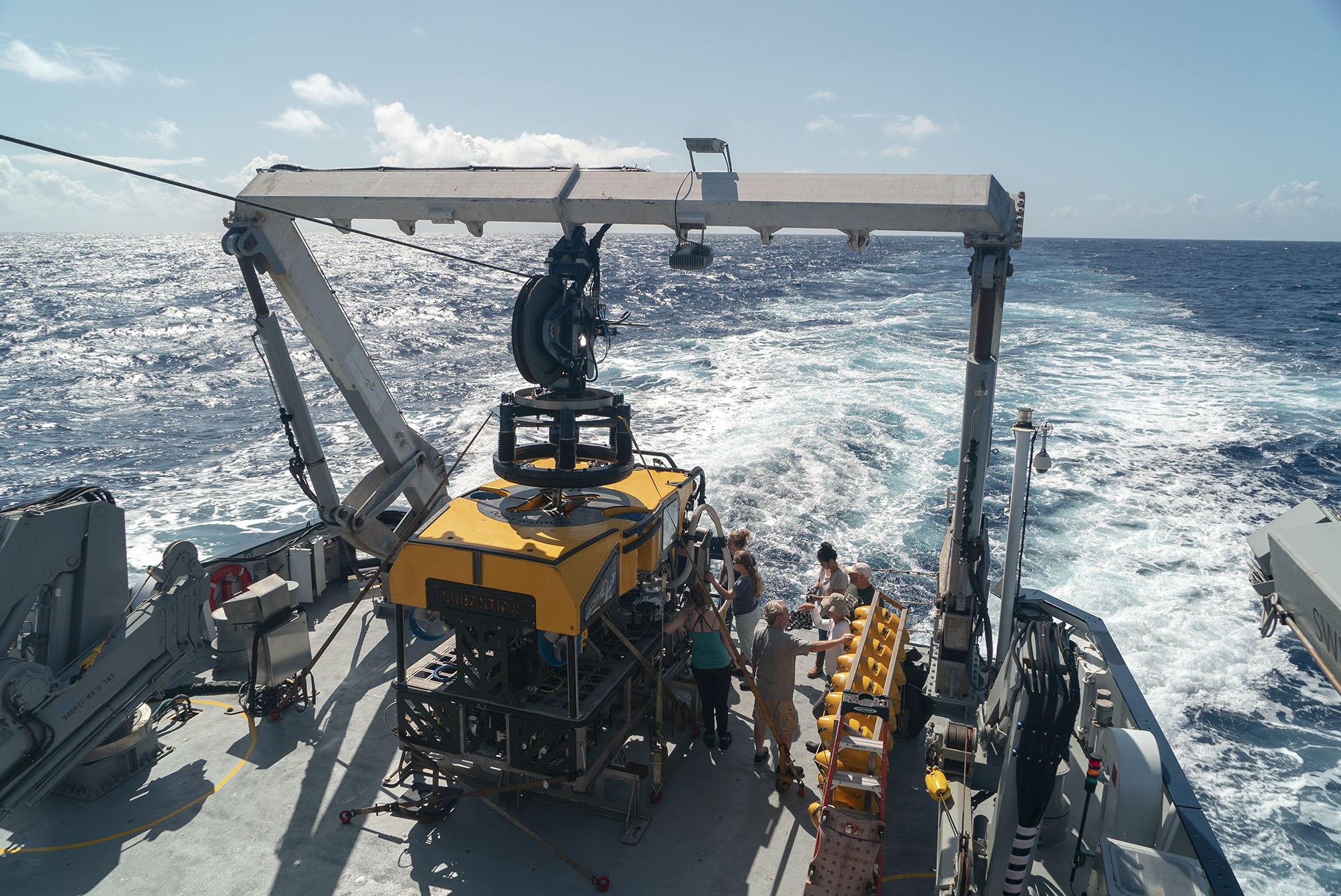

I am very excited to be part of the science team on the R/V Falkor heading towards the remote Emperor Seamount Chain, for both professional and personal reasons. I have spent a lot of my scientific life chasing questions that explore the biodiversity of the deep sea: How are there so many species living in this extreme (from our perspective) environment? Where did they come from? And why are some species found in some places in the deep sea, but not others?
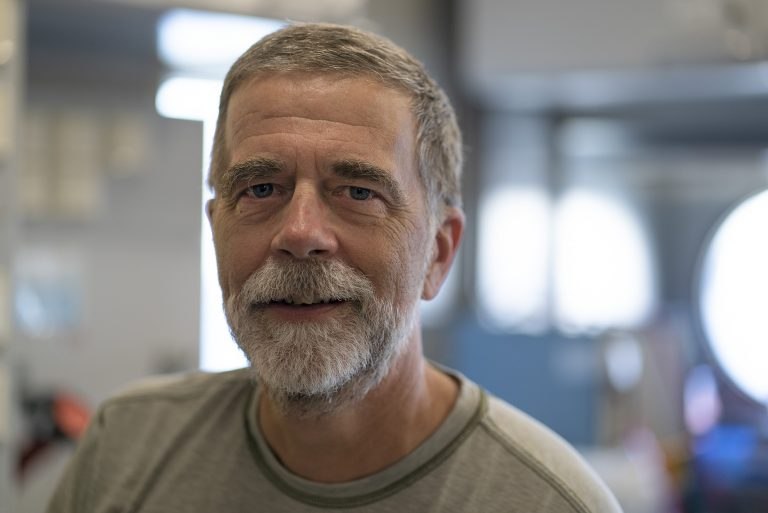
Dr. Scott C. France is a deep-sea biologist at the University of Louisiana at Lafayette. His research interest is the evolution and diversification of deep-sea invertebrates, in particular in deep-sea octocorals.[/caption]
Much of my work on these questions has focused on deep-sea corals, and I employ DNA sequence data to reveal the diversity and the evolutionary relationships entangling that diversity. In pursuing those questions, I have been privileged to work aboard a variety of academic and government research vessels, but this will be my first experience at sea on a private ocean foundation vessel.
Why DNA Sequences?
Some of you may have had the pleasant experience of standing on a beach watching bottlenose dolphins frolic in the ocean. What is not obvious is that the dolphins are genetically differentiated into three separate groups from inshore to offshore: that is, there are those that live in estuaries, others that live in the ocean close to the shoreline, and still others that live farther offshore. DNA sequence dataWhy the Emperor Seamounts?
Fifteen years ago, my colleague Les Watling and I were fortunate to be part of an expedition to the Aleutian Island chain studying the deep-sea corals of Alaska. Our prior experience had been in the deep waters of the North Atlantic and around Hawai'i, and although we recognized familiar groups of corals, the species we encountered in Alaska were new to us. Were they only in this far northern area because they are adapted to local environmental conditions or because they evolved there?
Since that expedition in 2004, there have been many studies in the Central and tropical North Pacific that show the deep-sea coral species characteristic of the southern region spread north along the Northwest Hawaiian Ridge (a long chain of seamounts extending from the main islands of Hawai'i) to at least the southernmost of the Emperor Seamounts. Where, then, does the transition to the Aleutian-type community occur, and what are the oceanographic conditions where that transition happens? There have been very few opportunities to explore the deep-sea coral fauna below 1000 meters depth on the Emperor Seamounts, so we may be the first to find out!
One of the reasons we know so little about the deep-sea coral communities of the Emperor Seamounts is that it is a hard place to reach. It will take us more than 8 days, covering > 2100 nautical miles from Honolulu, to reach our first station on Suiko Seamount