



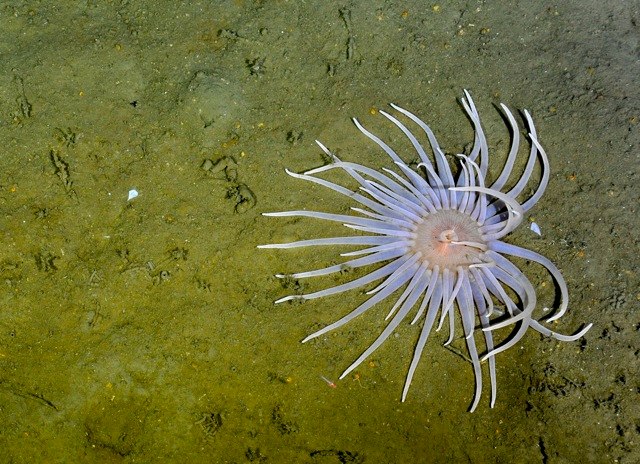

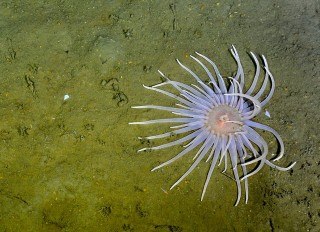
Today, on the expedition's deepest dive at 2,000 meters, ROPOS ventured through an area quite different from others we’ve explored. Toward the end, the team collected a coveted sample of what may be a new species of sea anemone, and that would prove a stark reminder of why it’s important to see an animal in its habitat to really understand it.
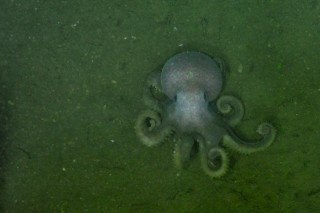
We’ve begun a new phase of work with the goal of running carefully planned transects along Barkley Canyon at specific depths. Ultimately the team will analyze all the video collected on these dives to assess which species are found at each depth, and their abundance. Comparing what’s found at depths below, within, and above the low-oxygen layer will mean better understanding how animals react to the low-oxygen challenge and which are best able to adapt to it.
Doing the transect meant flying ROPOS along 2,000 feet deep, as close to 2 meters off the smooth brown bottom as possible, for a full kilometer. Once that was done, the team spent the rest of the dive collecting samples of some of the larger animal species found along the transect. These are for species identification and for chemical analyses to determine their main food sources.
Wilted Flower
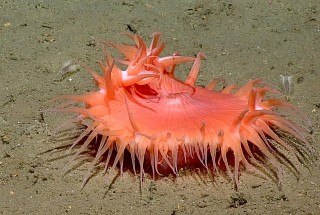
From the outset, the team also wanted to collect samples of animals that might prove to be species new to science. That was one of the reasons biodiversity expert Françoise Gervais
In the old days, that’s the only view scientists would have had of such an organism—probably worse because it would have been dragged up in a net to boot. But tools like ROPOS mean we get to see what an animal is really like, and can reveal behaviors that wouldn’t ever have been known. In the case of the sea anemone, there’s another species that hides within it and that would have almost certainly not been discernible with net sampling.
So the trick is being there, at least virtually. That may seem obvious enough, but gaining such access often remains a challenge with capable ROVs still somewhat scare. And sometime researchers spot likely new species, like a squid, but getting the samples needed may require tools not yet available. So there’s always room for technological advancement, and plenty of ocean yet to explore.