



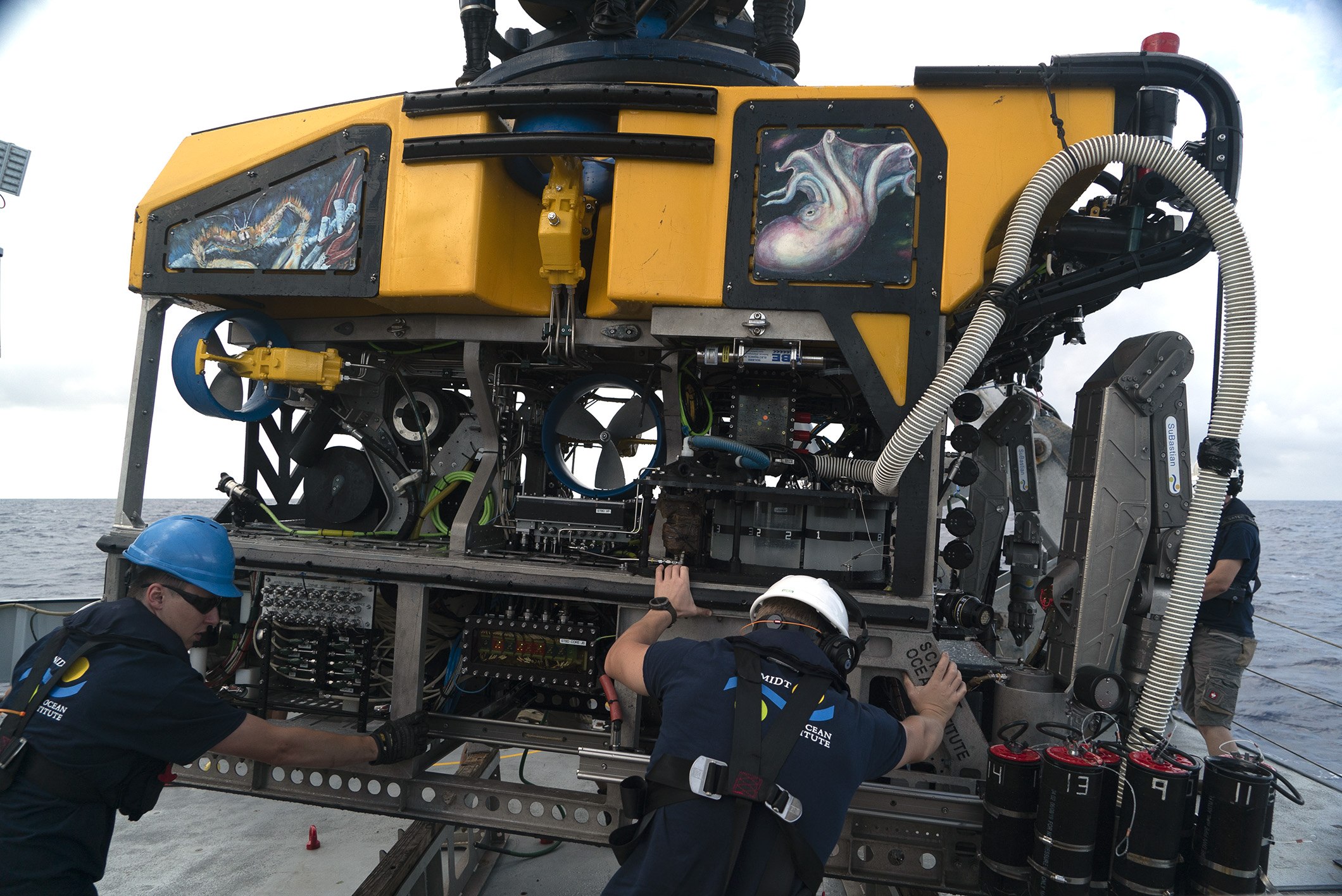

Designing adequate uses and parallel conservation strategies for the poorly understood 70% of the planet could appear daunting, but it is more attainable as researchers begin to divide the oceans into comprehensive segments. This is where biogeography comes in, which explores and explains "who" lives "where," and why.
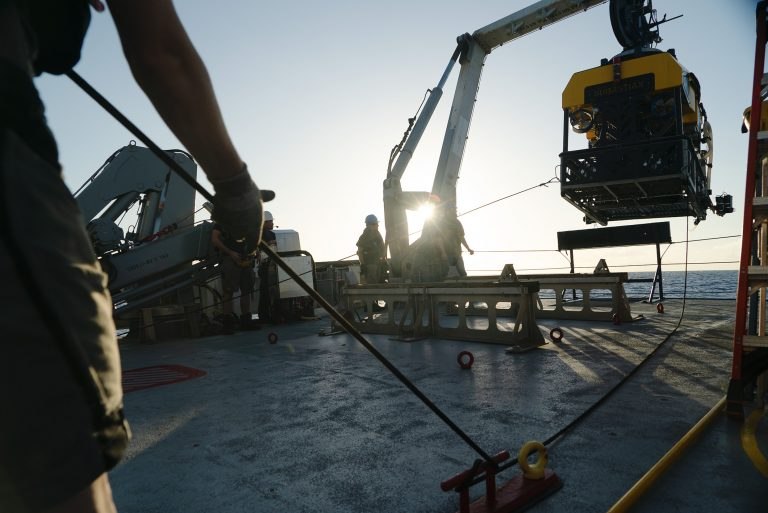
During the Necker Ridge expedition, the Remotely Operated Vehicle spent more time underwater than above it. This was one of the few times ROV SuBastian was recovered over the course of three weeks. It would rest on deck for a couple of hours, before being deployed again.[/caption]
Manageable Pieces
Scientists used to believe that all of the oceans were the same, that the same kind of life and conditions could be found throughout all waters and seafloors. We now know that this could not be further from the truth. The Pacific Ocean is the largest body of water in our planet, and for the past three weeks Falkor’s crew and resident scientists have made it their mission to identify the distribution of megafauna along Necker RidgeThe Verdict: Bridge or Barrier?
"We have a lot of lab work to do, a lot of video footage to review, a lot of genetic samples to start processing, a lot of paleooceanographic specimens to deal with and a lot of water samples to work on," says Dr. Roark. "We'll start delving into all of that work after a few weeks of rest, once we are back on shore."
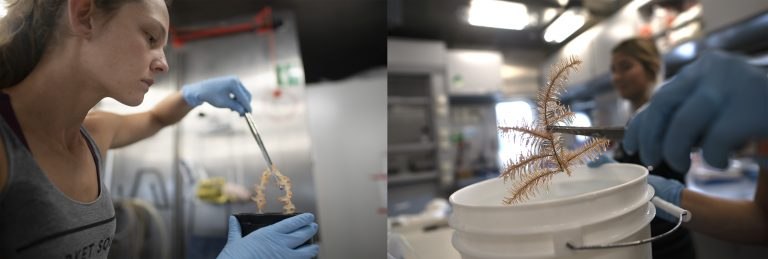
There are months of lab work ahead for the Necker Ridge expedition team.[/caption]
Still, some preliminary observations are possible. "We are seeing similar species between the Northwestern Hawaiian Islands and the Mid-Pacific Mountains," explains Nicole Morgan, Octocoral specialist and PhD candidate, "but the Mid-Pacific Mountains had much lower fauna than we would expect to see compared to previous knowledge of the Northwestern Hawaiian Islands. That suggests to me that it is difficult for larvae to move along Necker Ridge and recruitment is maybe not as frequent as we would expect."
"It is looking like recruitment along Necker Ridge is difficult, which may suggest that it is a potential barrier, but we do see some indications that recruitment is possible, yet limited," says Dr. Roark. When it comes to the boundary between biogeographic regions and the role that Necker Ridge plays in the recruitment of megafauna and the free flow of larvae in this part of the oceans, the jury is out. Months of laboratory work needs to be work to be done before a verdict is reached.
This was the first time that most of the seamounts observed during the Necker Ridge expedition were explored with an ROV. The pressures of humanity, however, reach as deep as ROV SuBastian’s diving sites. As deep-sea mining and fishing in these areas draw nearer, our understanding of community distribution and resilience must increase, and drive the next decades of of resource exploitation and impact mitigation.