Someone once said, “You cannot possibly design a less-interesting animal than a sea cucumber.”
To some extent, this is correct. Sea cucumbersFalkor’s ROV team may have a different perspective on this topic, though, and I think they are one of the most fascinating marine animals you could possibly encounter! Sea cucumbers are undoubtedly strong candidates in the marine beauty contest (if there are any).
Divers and scientists might be familiar with the following facts: they shoot their guts
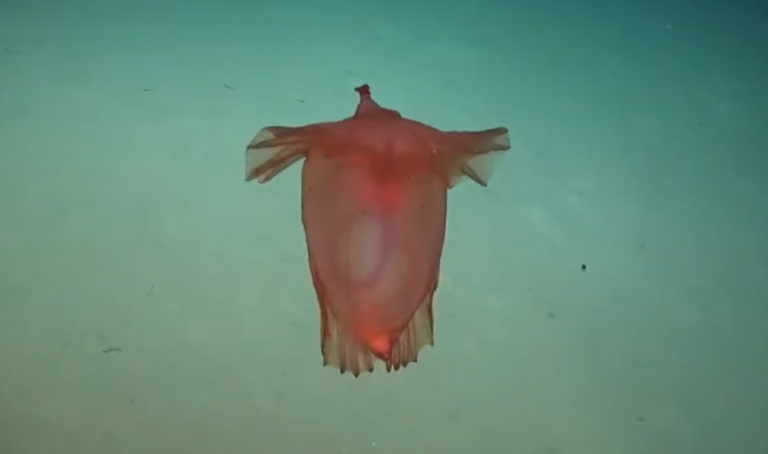
After seeing these sea cucumbers at depth with our own eyes, they seem a lot prettier than their shallower cousins. Holothurians usually have many morphological variations (spiky or smooth textures, dotted or mottled patterns, elongated or spherical body shapes). Their body walls can be translucent or even transparent, one of the most distinctive characteristics among deep-sea holothurian communities. Their internal organs are displayed like presents behind a Christmas shopping window—you just can’t shift your eyes away. This is because they have higher proportions of gelatinous tissue than collagens, keeping them neutrally buoyant in the ocean and allowing them to swim faster.
Yes, that is right—these deep-sea holothurians can swim. Actually, most sea cucumbers can. They are capable of facultative swimming, which means they will swim when there is an emergency. But for the most part, common sea cucumbers in shallow reefs just move very slowly with their tube feet or tentacles, like worms crawling. The so-called “emergency swim” is more like a sped-up rolling slightly above the bottom.
Deep-sea holothurians swim quite differently. We can still see the crawling trails they left behind, but more often, we see them ‘dancing’ around. Some of them (e.g., Enypniastes sp.) will use an umbrella-like brim swimming structure to lift the body vertically off the seafloor. In contrast, others can move around the water column by flexing the posterior portion of the body and combining a rhythmic pulsation from the anterior brim (e.g., Paelopatides sp.). Moreover, they can sustain such an active movement for more than 20 minutes!
Why are they swimming, and what are the evolutionary benefits of such behaviours? In 1990, Miller and Pawson from the Smithsonian Institution shared several assumptions. The swimming behaviour could be a result of avoiding predators and physical dangers, trying to find more food faster, or they might be absorbing nutrients dissolved in the water. Many more scientists are still trying to answer these questions.
The more I know about this beauty pageant contestant-to-be, the more I would like to see them around both in shallow reefs and in the deep sea, and to better understand them. They truly are a hidden beauty in the darkness.