



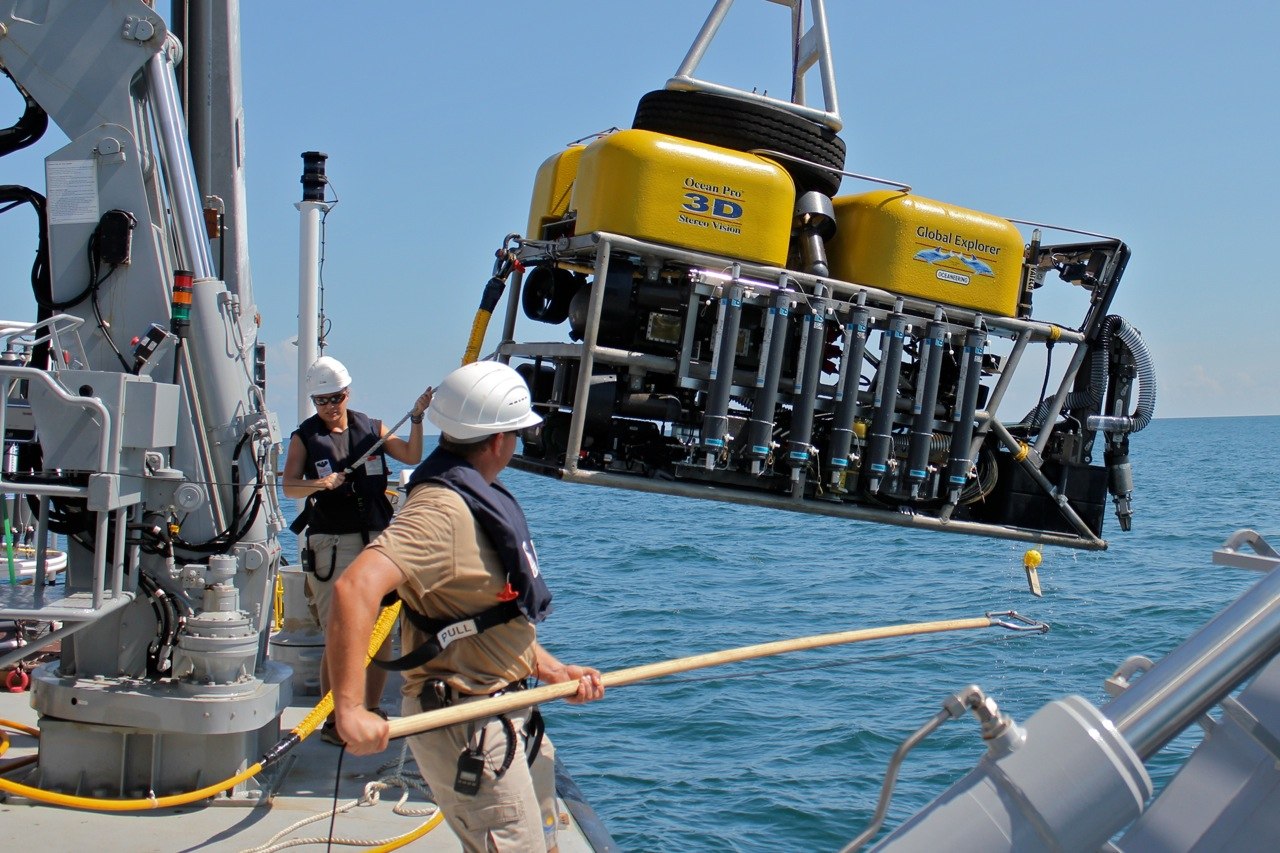

This was a shakedown to remember. It was the first time for many things aboard RV Falkor – the first time chased by a tropical storm in the Gulf of Mexico, the first time diving with a remotely operated vehicle (ROV), the first time mapping in rough weather, and the first time imaging corals in 3D, among other things. The ship and ROV performed admirably under adverse conditions. RV Falkor’s navigation and station holding were exceptional, and Global Explorer MK3 performed very well at great depths.
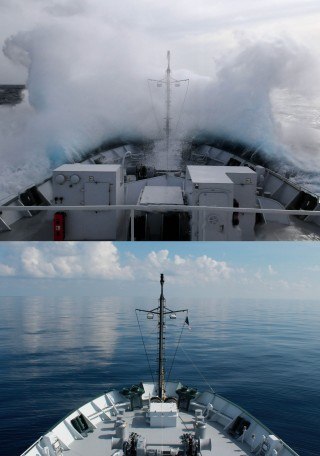
In the 12 day expedition, the R/V Falkor experienced dramatic changes in weather as a result of Tropical Storm Isaac (later Hurricane Isaac).[/caption]
To summarize the itinerary, the ship left St. Petersburg at midnight on August 26 and returned to Pascagoula at 8 pm on September 5th. The first three days were spent circumnavigating the as-yet-undetermined path of a growing tropical storm Isaac. Captain Bernd Buchner steered west ahead of the stormThe first ROV dive
The fourth day of diving brought a fifth dive to 1000 m depth in Atwater Valley 357. We encountered cold seeps for the first time. We collected water above seeps and Madrepora coral. As we explored new, deeper areas of a mound feature, we observed the largest sea fans of the expedition. Numerous shrimp, crabs, and brittlestars adorned each sea fan colony. Some colonies were toppled, perhaps due to the loose, unconsolidated sediment they had settled upon. Unfortunately, we did not stay long on the seafloor due to power failure. AT357 remains a high priority target for biological sampling in the future. Towards the end of the cruise, on Sept 4th, rough weather kicked up again, so Falkor steamed towards port.
Our Deep Coral Shakedown finished with four productive and rewarding dives, three full column CTD-niskin casts for water chemistry, and one exceptional map of the West Florida Escarpment. We have a total of 15 hours of 2D and 3D video to sort through, much of which features our target animals. Target selection was very good. We found corals at all four of our target sites, and discovered two new Lophelia aggregations on West Florida Escarpment. All in all, the cruise was very successful.
Thanks to the crew of the R/V Falkor from Schmidt Ocean Institute, the ROV team from Deep Sea Systems, as well as the science teams from Temple University, Woods Hole Oceanographic Institution, College of Charleston, and National Oceanic and Atmospheric Administration. This was a great team effort, and an unforgettable experience. Once again, mission accomplished!