




The starship Enterprise had one mission: to explore strange new worlds, to seek out new life and new civilizations, to boldly go where no man has gone before. Such an assignment - minus the civilization part- could be very well applied to the Coordinated Robotics expedition. Some of the experts on Falkor are avid Star Trek fans, so when tasked with giving their ambitious planning software a name, Enterprise was the one.
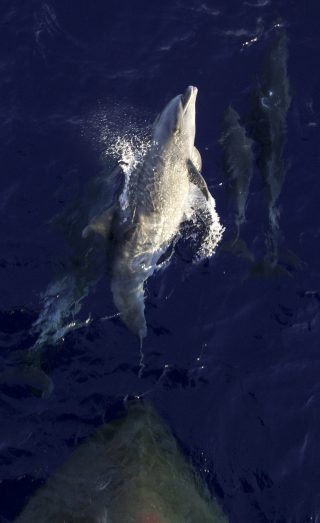
To the robots and their human counterparts, the calm waters of the Au Au Channel offer an environment as rich and challenging as outer space.[/caption]
To the robots (and their human counterparts), the calm waters of the 'Au 'Au Channel offer an environment as vivid and challenging as outer space. After all, today we know more about the surface of moon or Mars than we do about our seafloor. Every day, dive after dive, the robots' performances are improved as they learn new ways to communicate and operate. They do so through an intense process of trial and error, in which software development plays a key role.
Dr. Brian Williams, computer scientist and electrical engineer from the Massachusetts Institute of Technology
Uncertainty
Knowledge about a particular underwater location might be limited, putting scientists and engineers in the uncomfortable position of sending robots into missions with varying levels of risk. The team has developed the capability for the vehicles to operate within a safety margin, thus dealing with uncertainty. Today, they want to take that capability further by specifying how much risk the scientists are willing to take, then allowing the vehicles to make decisions throughout their missions, assessing the risks and adjusting accordingly.
“Communicating with the vehicles requires the right software to be created, and they all have different languages so we’re trying to develop interfaces for each, but that’s probably not the harder part of it,” Dr. Williams says. “The harder part is the algorithm. It has multiple choices and must try them all in all possible orders… that’s a huge set of possibilities. The algorithm must be able to try something and decide ‘Oh that didn’t work, why didn’t it work?’ and then rule out different options. So a lot of the time is us trying to get the software to work at that scale.” A scale that must now be multiplied by eight: the number of vehicles being tested during this cruise.