



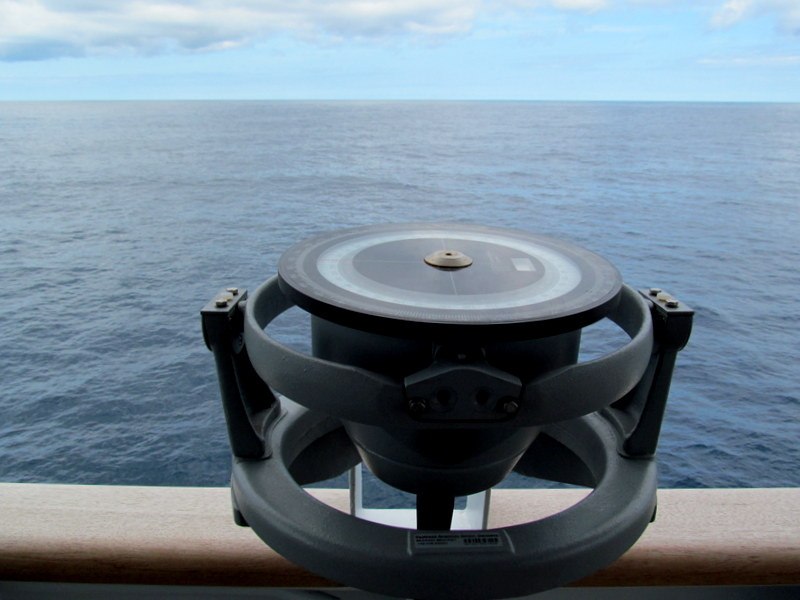

As the R/V Falkor made its way south past the Grand Banks of Newfoundland this sunny, calm morning, Second/Third Officer Paul Shepherd overheard Chief Scientist Dr. Cabell Davis talking to researcher Melissa Patrician about the sea ahead, which had a slightly rusty reddish hue in relation to the blue sky. Throughout the Falkor’s maiden voyage across the Atlantic, the ocean’s color has ranged from steel gray to midnight blue.
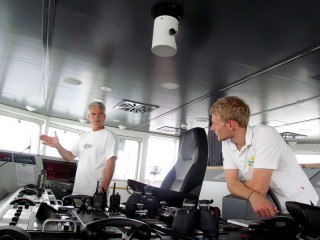
Dr. Cabell Davis (left), Chief Scientist aboard the R/V Falkor works with 2nd/3rd Officer Paul Shepherd to decide upon an ideal speed and heading for the next VPRII recovery.[/caption]
Officer Shepherd called the expedition’s Chief Scientist Dr. Cabell Davis over the radio and asked if he knew the cause of the unusual water color. Indeed, Dr. Davis had observed the phenomena in previous research missions and knew the likely cause was a bloom of phytoplankton called Trichodesmium
Trichodesmium was one of the first things observed by the original VPR when it was deployed in 1991, according to Davis. The crew observed other plants and wildlife consistent with North Atlantic Slope Water, including flying fish jumping out of the way of the ship, and sargassum weed. Later, after the ship had passed through the Trichodesmium bloom, the water appeared light blue at the surface.
Monday’s VPRII launch was delayed until 9 p.m. because researchers conducted one of the mission’s deep water Conductivity, Temperature and Depth Rosette (CTD) launches. They dropped the CTD to 5,000 meters. Tuesday, July 24, researchers deployed the CTD to 4,300 meters – both sites were among the deepest points in the Atlantic Ocean.
“We sailed from Bahia (Northeast South American Coast) … a few days afterwards, my attention was called to a reddish-brown appearance on the sea. The whole surface of the water as it appeared under a weak lense, seemed as if covered by chopped bits of hay, with their ends jagged … Mr. Berkeley informs me that they are the same species, Trichodesmium erythraeum, with that found over large spaces in the Red Sea, and whence its name of Red Sea is derived.”
-The Voyage of the Beagle, Charles Darwin (1839)
March 18, 1832 voyage notes