



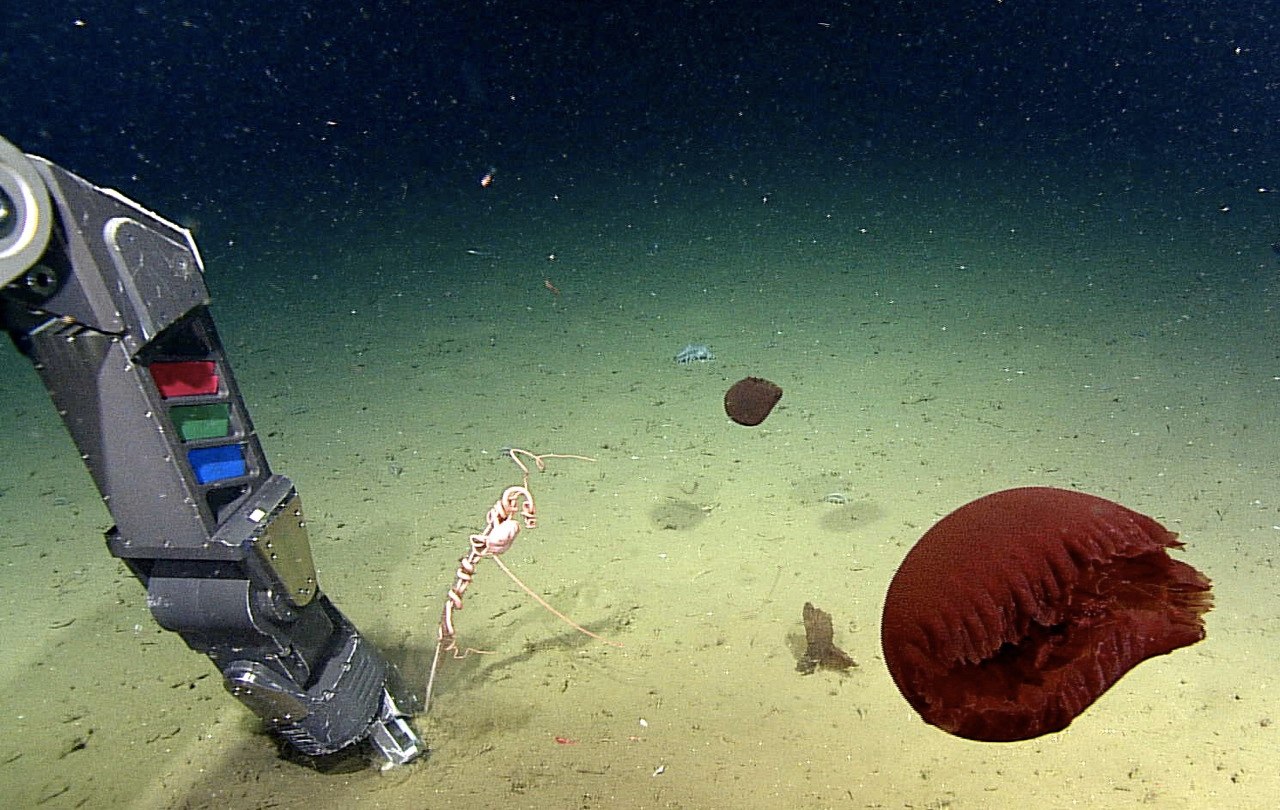

It was strange. All of a sudden, working across the canyon at 800 meters, a cloud of sediment had engulfed the ROPOS ROV. You couldn’t see much of anything. But the cloud didn’t seem to be flowing down the canyon, as you would expect if sediment on a slope had given way somewhere. Instead, the sediment storm was making its way up the canyon. It was something of a mystery that was going to take a little thought to figure out.
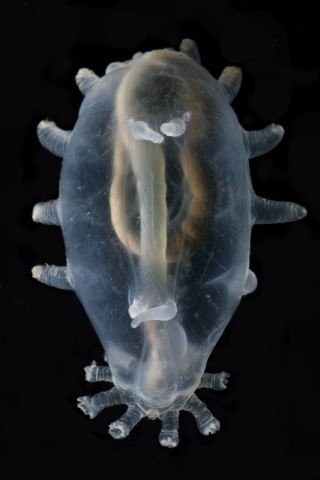
But the day started in clear waters, at about 1,500 meters, at the lower end of the oxygen minimum zone
That underwater equivalent of a dust storm happened on the second dive. The severely clouded water lasted for about 200 meters across the canyon, and was about 20 meters high. One idea is that it was the work of tidal currents. Juniper and Karen Douglas checked the charts and found that the “storm” was just past a sharp turn in the canyon. So it’s possible that a current was knocking sediment off at the turn and carrying it up the canyon. They’ll be checking data from the NEPTUNE observatory to see if tidal and other data match this hypothesis.
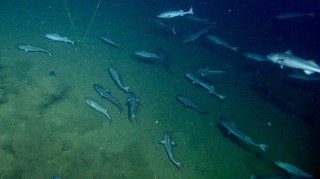
Another striking feature of the dive was sable fish by the hundreds. “I’ve never seen that kind of concentration before,” says Juniper. And because the fish are attracted to light, they followed ROPOS like a bunch of groupies as it moved along.
Other animals were much more scarce because at 800 we were in the heart of the low oxygen zone. There were very few sea stars and sea cucumbers, for instance, but as the sablefish reminded us, it’s certainly not a lifeless place. A number of animals do quite well here, just not all of them. “What we were seeing in this area was a look at a future ocean if the lower oxygen zone is expanding,” says Juniper.
The day ended with a spectacular lightning storm that seemed to surround the ship, but the weather is till treating us quite well. We should have no problem finishing out the slate of planned dives. Tomorrow morning early, we’ll be on the way down to 600 meters.