



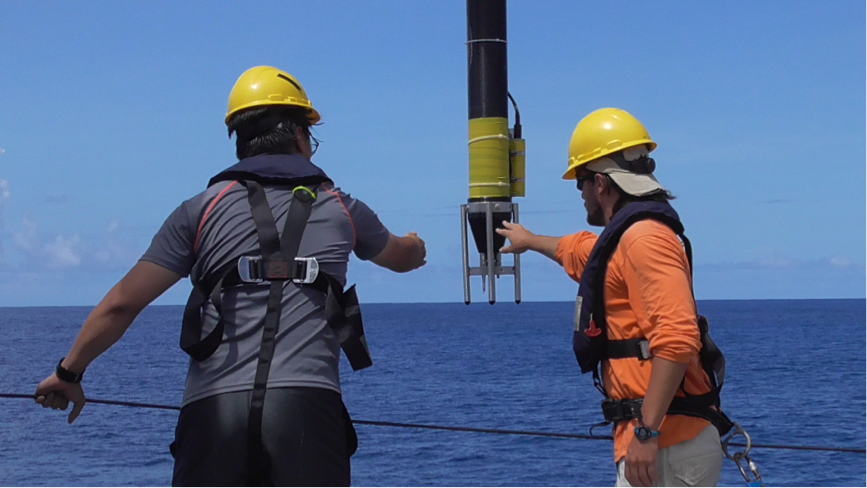

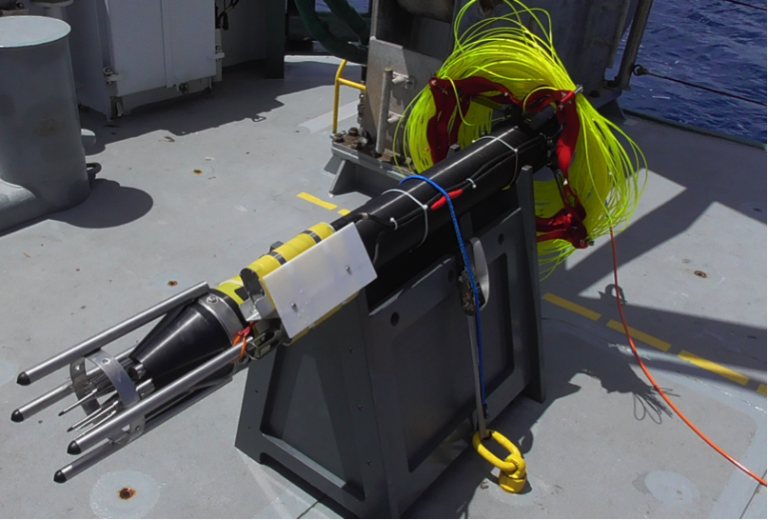
Of the two specialized instruments aboard Falkor, the Vertical Microstructure Profiler (VMP) is the interesting looking one. Torpedo-shaped with probes jutting out of the tip, it’s almost as intriguing to learn about the internal-workings, as it is to gaze upon its glory. The VMP is rated to 500 meters (1650 ft), meaning that it can take important oceanographic measurements down to this depth. Weighing between 30-40 pounds, the VMP is also light enough to operate without heavy equipment such as a crane.
VMP expertise onboard
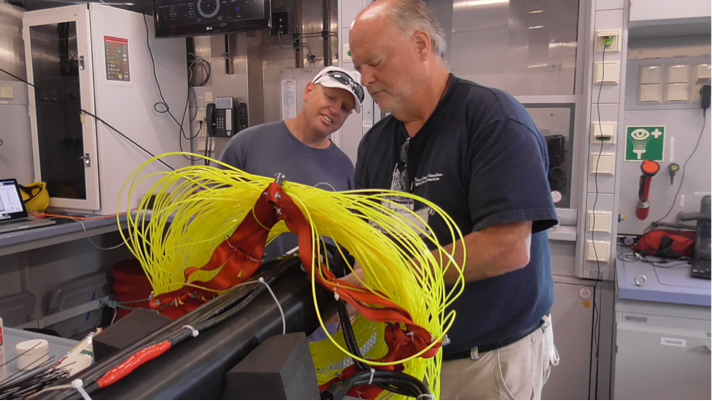
Andrew Cookson, a Senior Field Engineer at University of Washington’s Applied Physics Lab, is onboard helping with the VMP. Andrew worked for Mike Gregg, who was influential in the development of microstructure instrumentation, and is one of a handful of engineers with experience maintaining microstructure instruments. On this cruise, he is constantly innovating the drag element design with better data collection in mind. Always up for conversation, Andrew has ineffable charm that draws in everyone he meets. “Some scientists are of the opinion that, well, we’ve always done it this way, why change it? In reality, innovation is a crucial element of science, especially at sea. It also happens to be my forte,” says Andrew with a proud grin.
Glenn Carter
The ideal rate for the VMP to descend into the water column is about 70 cm/second. The faster it falls, the more difficulty temperature probes have keeping up; however, the shear probes record velocity better if the VMP falls faster, so it’s a sort of trade off. In order to reach the 70cm/second goal, drag elements are attached to the tail fin to slow the fall. On this cruise, the science team has been able to achieve between 72 - 88 cm/second so far, and each VMP drop is a new trial to further innovate the design of the drag element.
Probing the depths
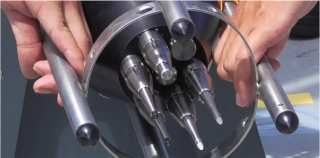
At the tip of the VMP, there are six slots for probes, but you choose how many you need. On the Mixing up the Tropical Pacific cruise
Four highly sensitive, probes about the size of pencils are inserted into the nose of the VMP. These probes are protected by a halo shaped probe guard, which can potentially disturb the water, aka, “shed eddies.” Since we only want to collect data about turbulence already present in the water, one of the probe guards is covered by a pipe cleaner. The pipe cleaner works by breaking up the disturbances caused by the probe guard, preventing the sensors from being affected. As with most tools, scientists must experiment with the equipment to figure out the best possible way to generate good data. The science party has tried several different probe guards and once they take a look at the data, they will select the method which produces the cleanest data.
Deployment & recovery
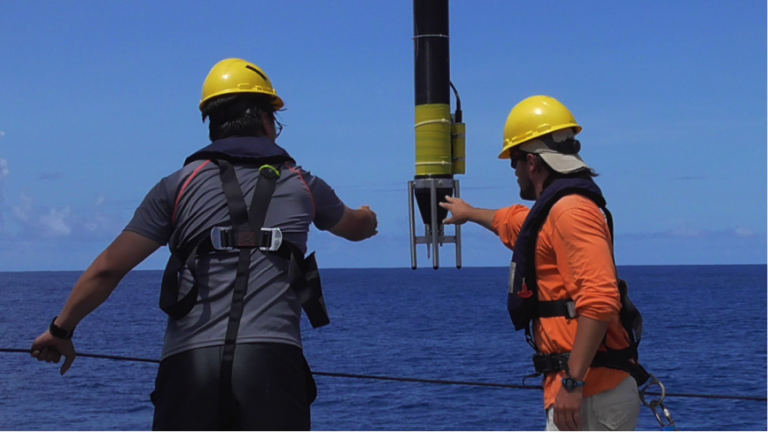
A VMP drop is a team effort. One person at the winch controls the raising and lowering of the VMP itself, while two steady the VMP as it goes overboard, and a handful of the ship’s crew control the A-frame. Safety is always the number one priority, so everyone must wear hardhats and floatation devices. The VMP is currently being deployed every half degree as we navigate south on 170 West. The team hopes to gather data that will enhance understanding of oceanic microstructures within the eastern equatorial Pacific Ocean, with the help of our trusty VMP!