



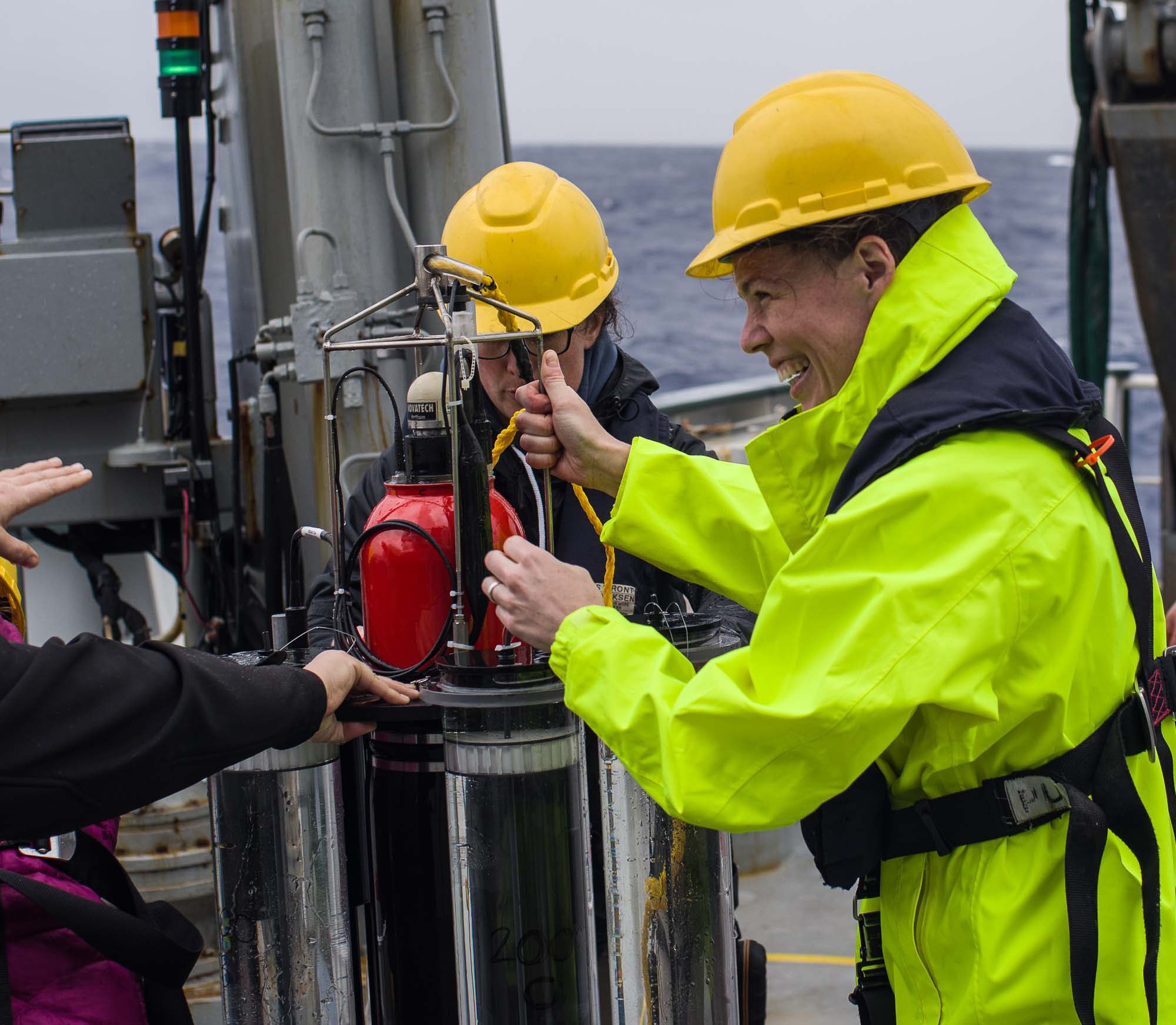
As the bright yellow line and blinking strobe slip slowly down into the heaving waves, I feel a familiar sense of unease. Even though I have seventeen successful deployments of free-drifting, neutrally-buoyant sediment traps
Mass and Volume
On deck and lifted up in the air by a crane, an NBST ready for deployment weighs about 160 pounds. It is awkward and top-heavy with its seawater-filled trap tubes attached. But in water, it weighs only about 5 pounds and drifts gracefully.
A small change in mass or volume – equivalent to the weight of a butter knife or the volume of an apple – can make the difference between the NBST getting trapped at the surface or sinking like a rock. I have calculated the density of the ocean water around us, precisely adjusted the NBST’s mass, and conducted a series of tests at the dock, so I am fairly confident it will be able to sink as intended, and return to the surface easily. In spite of all this I will spend the next five days worrying about the weather, the batteries, and the accuracy of my earlier weight adjustments, as I always do during the first deployment of the cruise.

Chief Officer Philip Guenther makes sure the NBST returns safely to Falkor's aft deck after it spent three days collecting falling particles at a depth of 150 meters.[/caption]
Success!
Wednesday night my anxiety is over. Just after sunset on the Bridge of Falkor, the Lead Marine Technician, Colleen Peters is the first to spot the flashing white strobe light in the intervals between the swells. As the crew snag the yellow line and lift the NBST back aboard, a weight lifts from my shoulders. Now I can truly look forward to the science we will accomplish over the next three weeks!
The NBST has returned samples of the sinking particles filtering down from the surface ocean over the last three days. The particles include aggregates of phytoplankton, zooplankton waste materials, and solitary cells. My colleague Dr. Colleen Durkin