



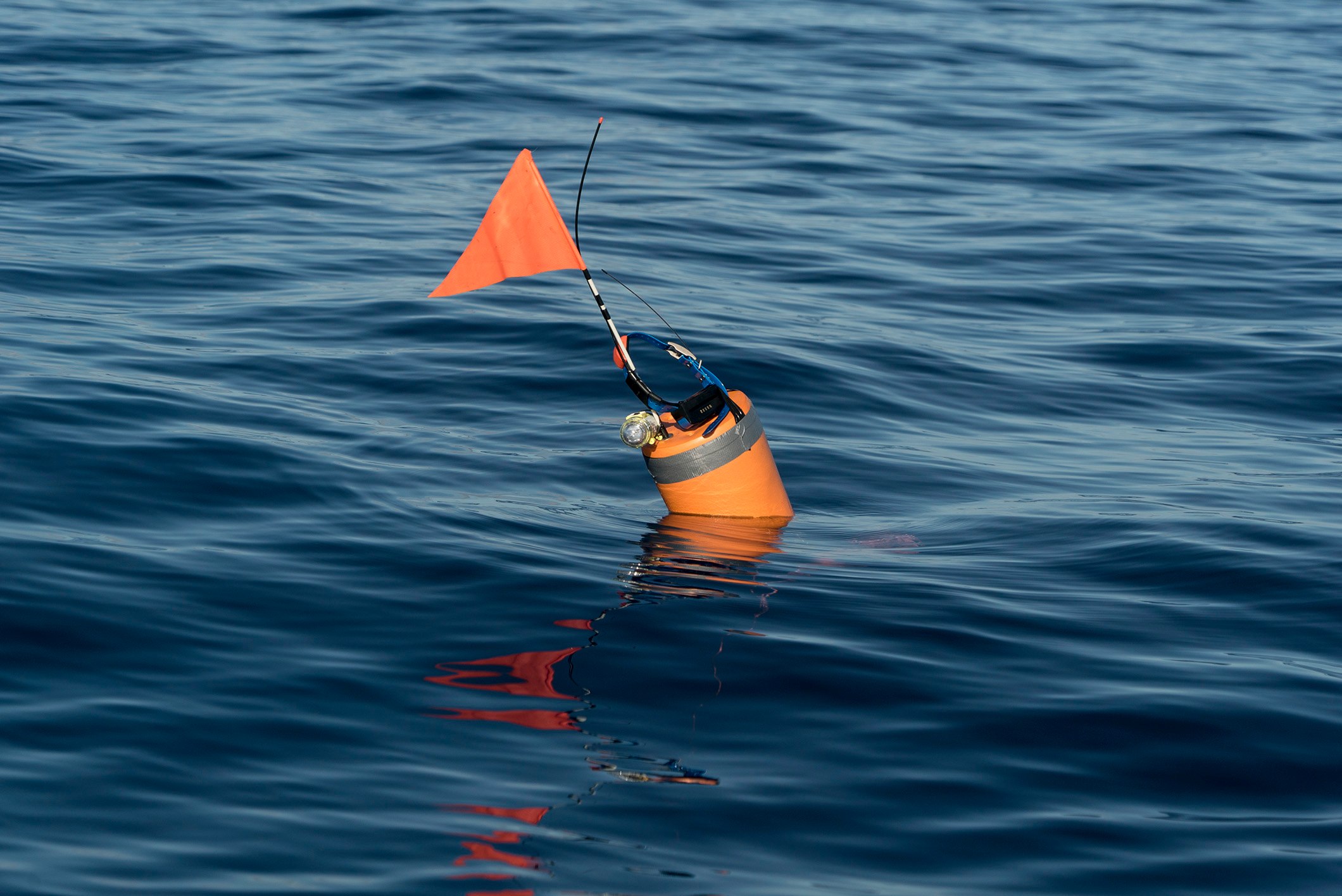

On R/V Falkor, several Autonomous Underwater Vehicles (AUVs) are being optimized individually. Meanwhile, the team is experimenting with artificial intelligence that will enable the machines to assess risk, complete missions, and replan actions in conjunction. At the same time, software is being developed to act as an umbrella that keeps track of operations by displaying maps of the seafloor, tracking the vehicles underwater and monitoring other vessels navigating in the vicinity. Simplicity does not seem to be the order of the day, yet the resident engineers are constantly looking for elegant and straightforward solutions to attain their ambitious objectives.
Dr. Roman deploys the Lagrangian Float. It weighs 30Kg, making it much simpler to manage than most AUVs.[/caption]
Keep it Lagrangian
As far as AUVs go, it does not get much simpler than a Lagrangian float. Lagrangian is a term coined after the French mathematicianJoseph-Louis Lagrange. “There are two ways of describing fluid flow, or the way water and fluids move,” explains Dr. Chris Roman of the University of Rhode Island (URI). “One is Eulerian, which means you sit there and you watch the water go by.Lagrangian means you drift with it to see where it is going.”
Dr. Roman’sLagrangian float can only control its altitude - or its distance from the seafloor - as it simply drifts along with the currents. “Once you throw it in the water, it can go down to a depth, but then it has no ability to drive around: it can only go up and down,” says Dr. Roman, whose team is in charge of optimizing the float during this expedition. “The float is really on the end of the spectrum with regards to simplicity; it is probably the cheapest vehicle you are going to get to collect images of the sea floor.”
The float is depth rated to one hundred meters, which means it can only do relatively shallow dives. Such constraints might make it seem like a limited tool, however what the URI float aims to do, it does very well.
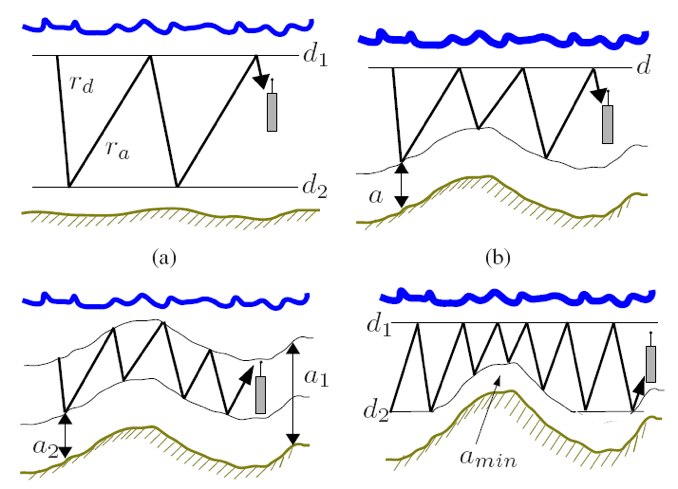
Several diving profiles can be programmed for the float. By detecting its altitude with regards to the seafloor, the float is able to maintain a constant distance.[/caption]
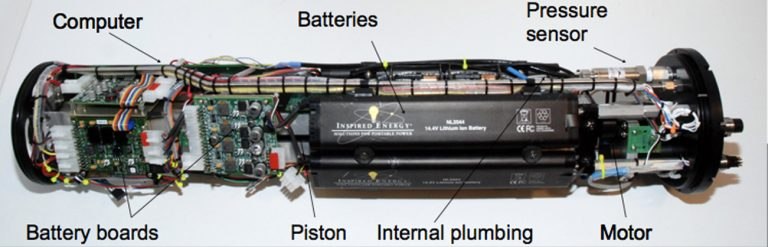
This is the interior of the photo float. It is a light-weight (approximately 60 lbs.), simple platform that consists of an aluminum tube with batteries, electronics, and a computer inside.[/caption]
Snap
There arethousands of Lagrangian floats drifting in the deep ocean today, collecting data about ocean circulation, most notably for the Argos
Practicality
The Lagrangian float can take nice images but can not steer itself to specific locations or points, which is why it is intended to be used in combination with other more complex AUVs. For instance, in one scenario the float canbe used to explore new areas. When its cameras detect an interesting feature or habitat,a more capable AUV would be deployed to take a closer look in a systematic fashion.
The Lagrangian photo float simply drifts with the currents.[/caption]
“Let’s say in the first year of a habitat assessment you go out with AUV Sirius