





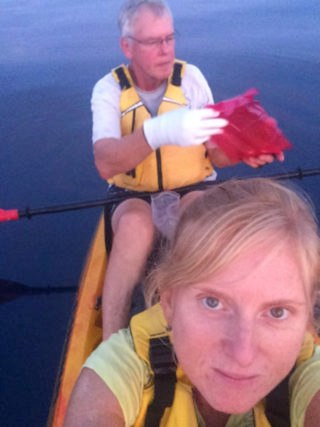
Pre-dawn sampling from the kayak. As we are interested in measuring extremely low concentrations of metals in the microlayer and underlying water, we have to do this away from the steel-hulled Falkor. We also need to wear gloves so that we do not contaminate our samples.[/caption]
I am one half of the trace element sampling team - mentioned in an earlier blog post
Everything is Connected
Once such group that really are extraordinary is the genus Trichodesmium, a.k.a. sea sawdust. Trichodesmium species are from a group of organisms called diazotrophs, which means that they are able to meet their nitrogen requirements by fixing nitrogen directly from the atmosphere, rather than taking it from the surrounding water. This gives them a huge advantage as they are able to live in parts of the ocean that have extremely low nitrogen concentrations; the marine equivalent of deserts on land. However, this comes at a cost. Nitrogen fixation requires a lot of iron, which is a problem in large areas of the open ocean. Fortunately, the atmosphere can be a source of iron, transported by winds, and primarily sourced from the world's terrestrial deserts. Everything is connected! Seeing the huge ‘slicks’ of Trichodesmium from the ship told us a whole lot about the chemical composition of the water we were sailing through, but it also raised the question of the source of atmospherically-transported iron. Was it coming from the red interior of Australia? Certainly this is a possibility, but our filters didn’t look much like the orange-red soils of the Australian desert. Instead they were a sooty grey. Pollution? But from where? Darwin cannot exactly be described as a major population centre. The answer lies in the time of year. We left Darwin just at the end of the dry season, when prescribed burns are a common measure to limit devastating wildfires. In technical terms, this is referred to as biomass burning. Is it pollution? Well that depends on your perspective. Is it a source of iron? Not directly, but organic compounds associated with the burning material helps to increase the solubility (the amount that can dissolve in the water) of the iron (yes, iron can dissolve in water!), thus allowing the biota to access it.
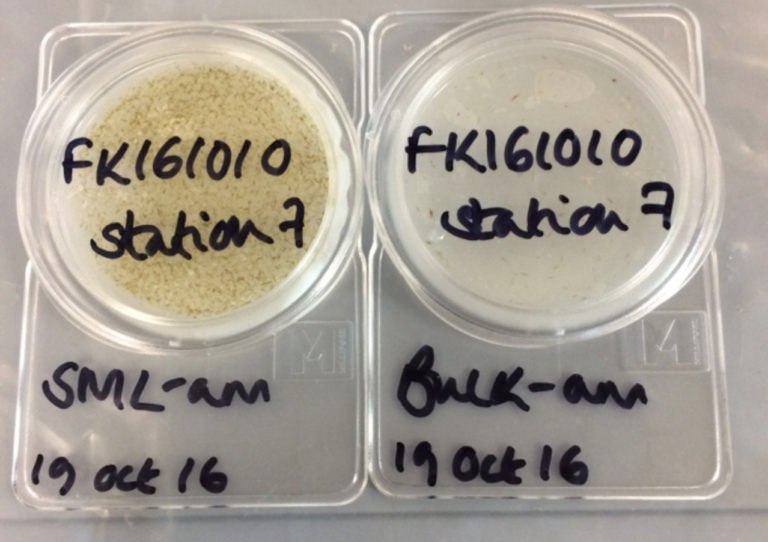
Filters of the microlayer (SML) and underlying water (bulk) show that the Trichodesmium are concentrated in the microlayer[/caption]