




Oceanographers, marine biologists, acoustic researchers, a Student Opportunities Participant, and an Artist-At-Sea: the team of the ‘Listening for Cryptic Whales Species’ cruise has come on board for an exciting cruise that focuses on investigating species of whales around the main Hawaiian Islands. This includes species of beaked whales, which have been called “the least understood group of large mammals on Earth.”
Data about marine mammals (such as beaked whales and false killer whales) is crucial in order to assess their status and to understand the impact of human activity on their populations. However, this data is currently extremely limited due to the rarity of the mammals themselves. The Cetacean Research Program
Tracing The Giants
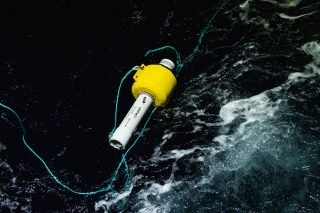
Despite their size, the whales this project focuses on are very difficult to track, identify, and study. One key to understanding them is technology: in this case three acoustic recorders (Drifting Acoustic Spar Buoy RecordersEnvironmental DNA
eDNA analysis is a pioneering technique that allows researchers to collect the DNA of all organisms within an environment (in this case the ocean) without direct contact. Rather than sampling directly from a single creature - using methods which have high miss-rates and are logistically challenging (such as biopsy sampling via crossbow bolts) - eDNA provides scientists with data from all the organisms that have interacted with the water. As these creatures move through the ocean, traces of their DNA begin to accumulate in the surrounding water. By analyzing these traces, the team is able to detect individual species and to gather a picture of the area’s biodiversity without disturbing the animals. Then, by combining eDNA sampling with acoustic recordings, Dr Allen’s team will be able to start understanding vocalization patterns in relation to group composition and sex. This type of information is valuable for rare or endangered marine mammal species such as beaked whales and false killer whales.
Opening Our Eyes and Ears
In addition to the free-floating acoustic recorders (DASBRs), 24-hour data recording, the R/V Falkor’s CTD (upon which an acoustic recorder will also be mounted), and eDNA analysis, an important aspect of the project is less high-tech but equally important: visual surveys. During transit periods to sampling sites, someone will always be on lookout for whales. If spotted, the crew of the R/V Falkor and the science team will be ready to deploy the small boat, Atreyu. Given an opportunity, the team will get as close as they can to any whales for photo IDs, biopsies, and surface eDNA sampling.

Very little is known about the Hawaiian Islands’ beaked whale populations, and the potential impacts of human activity in the area. Despite their size, these mammals are incredibly elusive. This project’s findings will help to fill huge knowledge gaps, greatly increasing our understanding these rare cetaceans. One species of beaked whales in Hawaiian waters, the Cross Seamount Beaked Whale, has only been identified by its vocalizations to date. Thus, the project has the potential to open both our eyes and our ears to a wealth of knowledge.