
Para leer este blog en español, haga clic aquíThat Was Then
Now, technology is much more capable. By enabling the robots to interpret information coming in from their sensors and subsystems, the engineers expect them to better "understand" their environment and choose - on their own - which areas and aspects to focus on to achieve mission goals. The robots will then adjust strategy accordingly, including when to come back and share their findings with humans.
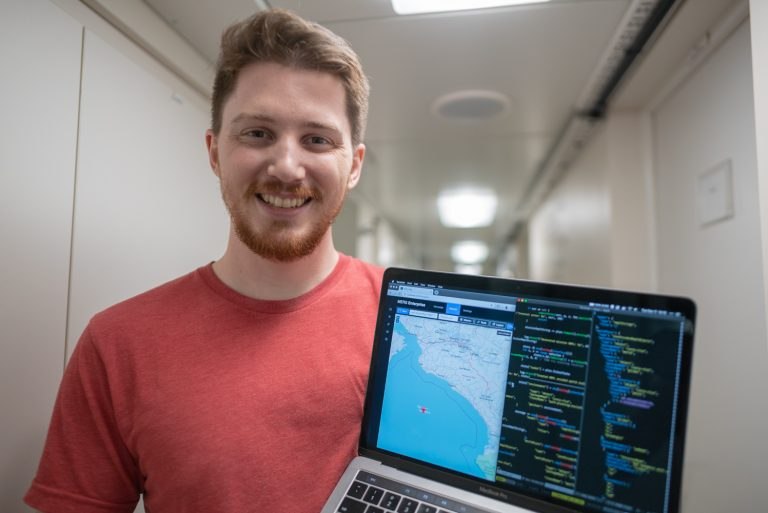
Falkor hosts a team of engineers and scientists, collaborating together to take this technology even further. Engineers are incorporating the scientist's knowledge into the decision-making tools being developed. They are effectively sharing the scientists' thought-process with the robots, making the machines more discerning and intelligent. "We can take magnetic readings of the seafloor, for instance, and see where there are areas of magnetic variation," says Nick Pascucci of the MERS MIT lab, a group that focuses on spacecraft autonomous systems. "We can see how that relates to other things, like the fauna on the seafloor that we might want to investigate more. So what a scientist would do is to see what all of those interrelationships are and then make decisions based on the data.Our AI is able to do that same kind of reasoning- as we get more information, we update our belief of where interesting phenomenon may occur, and then we’re able to tell the robot, ‘Hey, I want you to go and find things that are interesting for us based on what you know already'." This way, the robots are able to automatically consider a large number of possible goals and pick the best ones to continue their mission.
This would even enable the vehicles to adjust their mission: "The robot would use all the information acquired to make decisions on how to manage its power usage and deal with faults that may be occurring, so that it is resilient enough to continue its mission even in a degraded state," explains Dr. Richard Camilli, Chief Scientist. "In some cases, if one of these vehicles encounters something that’s particularly interesting, it may stop the mission and start an entirely new one on its own, to survey that area in more detail."
Brains and Tools
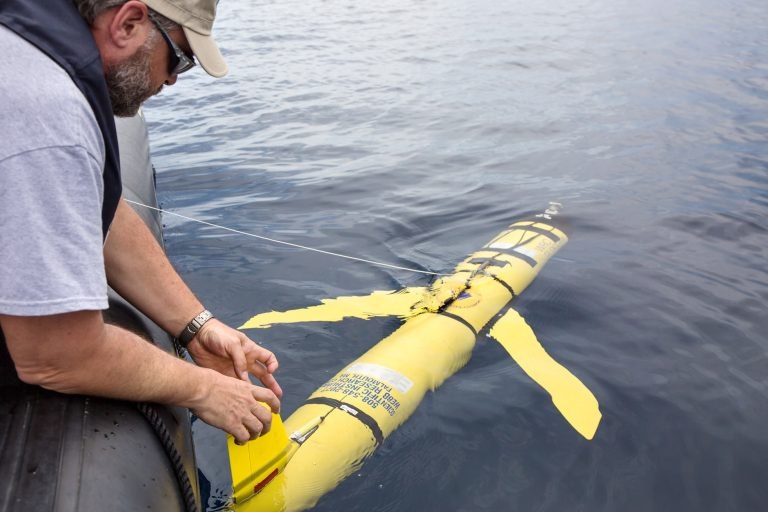
The robots are getting improved "brains" so they can capitalize on the tools they carry. Both Nemesis and Sentinel carry a standard suite of oceanographic sensors for conductivity, temperature, and depth, but additionally, one carries a magnetometer and the other an advanced sonar system. The magnetometer is used to identify variations in the Earth’s magnetic field, helping locate different geologic strata. The sonar allows the robot to identify seafloor features in terms of the bathymetry and backscatter. This in itself is truly an astonishing technology, which only gets more impressive when one considers the incredible efficiency of these vehicles. "One of the big differences here is that we’re using a minimalist infrastructure," says Dr. Camilli. "These vehicles are small and need very little power: To put that in perspective, the entire power budget of one of these gliders is on the order of what a cell phone takes. That includes all of the computation, all the communications and all of the propulsion. So they have to be super efficient in terms of how they carry out their missions and in terms of when they communicate."
The deep sea can be extremely perilous: the pressure from the water's weight alone would easily crush a human. Machines can withstand more punishment, and that is why experts are trying to produce cheaper and more capable robots. During this expedition, the goal is to learn best practices for search strategies and mission management, in terms of both individual missions for one vehicle and for an entire campaign of coordinated robots, all sharing information and making "wise" decisions that are scientifically meaningful.
Humans are intelligent and versatile creatures, but there is no way we will be visiting some of the places the robots can go any time soon. For now, Nemesis and Sentinel are our best bet.