



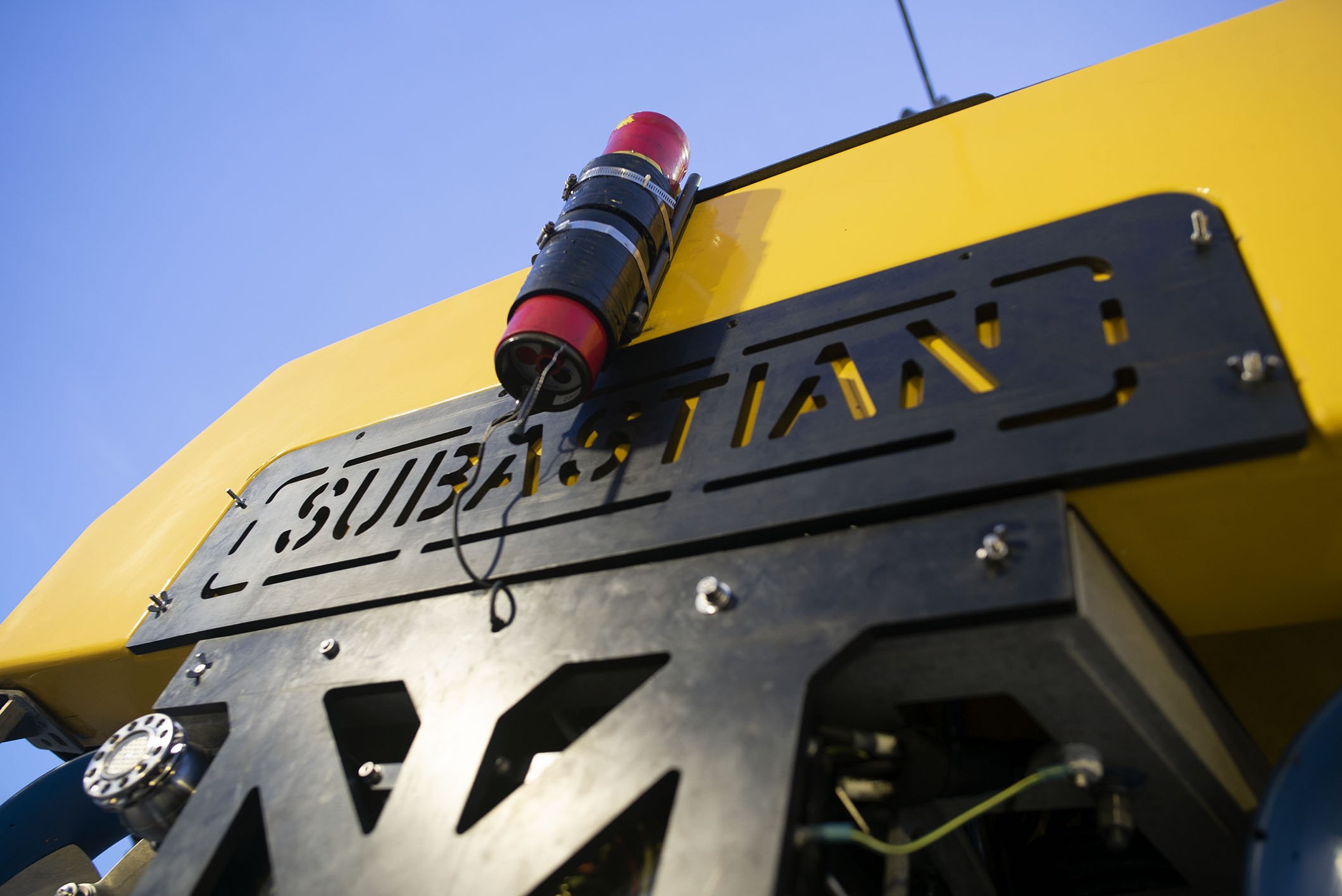

Dr. Les Watling observed patiently as the ROV team ran through the pre-dive checklist, making sure ROV SuBastian was ready to complete another successful mission to the deep sea. After hours of high resolution multi-beam mapping, the experts on board zeroed in on one promising area of the Suiko seamount: a rough protrusion near the top, which could produce a disruption in the flow of the current, lifting nutrients from the seafloor and creating favorable conditions for the growth of octocorals. As ROV SuBastian entered the water, Dr. Watling said: "It's all going to be interesting, no matter what we find."
The dive was informative, but not particularly exciting from a visual point of view. Although there were a fairly high number of octocoral colonies observed, they were very small, most of them white, and generally only two species. This did not dampen the motivation of the team, as they did find one very important clue: after verifying samples using microscopy, they can confirm that one of the primnoid octocorals they collected from 2280 meters depth is in the genus Arthrogorgia. ArthrogorgiaUncovering the pieces
Biogeography is a branch of geography that studies the past and present distribution of the world's many animal and plant species, therefore shedding light on the natural habitats around the world. Each biogeographic region represents an area of animal and plant distribution that has similar or shared characteristics throughout. Inside each region, ecological communities have the same climatic conditions and geologic features that support species with similar life strategies and adaptations.
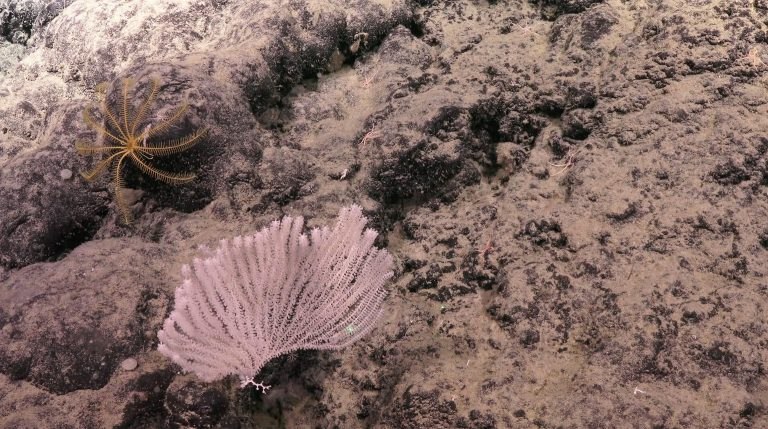
This is the first time a seamount on the Emperor chain has been explored using an ROV. In the past, samples have been collected using destructive trawling practices.[/caption]
Biogeography is essential in understanding why species are at their present locations, as well as in developing protection and management plans for natural habitats. "The biogeography of the shallow part of the ocean has been known for a long long time," explains Dr. Watling. "The problem is that up until six or seven years ago there was no general scheme for biogeography in the deep part of the ocean." Dr. Watling's team proposed two large biogeographic areas for the North Pacific, and locating the transition or the boundary between those two areas is important to understanding our oceans in general and in particular for conservation purposes.
Organisms evolve according to the water they live in, which is why Dr. Watling has put together an interdisciplinary team that will not only be able to identify the lifeforms SuBastian encounters but the characteristics of the environment itself. The team knows that for six months of the year, the North Pacific is very productive due to the great amount of sunlight it receives, which enables primary production from phytoplankton in the surface of the ocean. Nutrients produced in the sunlit layers of the ocean are ultimately exported to the deep seafloor through different natural mechanisms, which would suggest that abundant life could thrive on the deep seafloor. Still, literally, no one knows. A search for OctocoralliaWater Wall
About halfway across the Emperor Seamounts, there is a current stream that flows from either West to East, or from East to West. Since no water flows from North to South, it is referred to as a water wall - a sort of gyre separates this part of the Pacific from the rest of the ocean, and it has done so for a long time. Fish and corals here are completely different; they have evolved in isolation through geological time.
For the longest time, the deep sea was thought to be azoic