
My name is Kelly Luis and I am a PhD student at the University of Massachusetts-Boston. I study ocean color from remote sensing platforms and on this cruise, I am ground-truthing
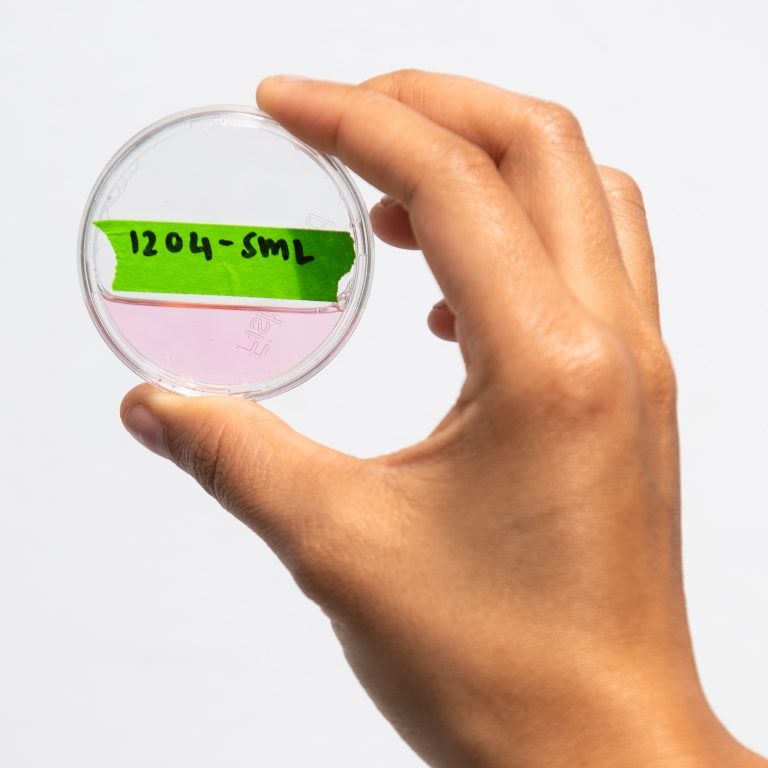
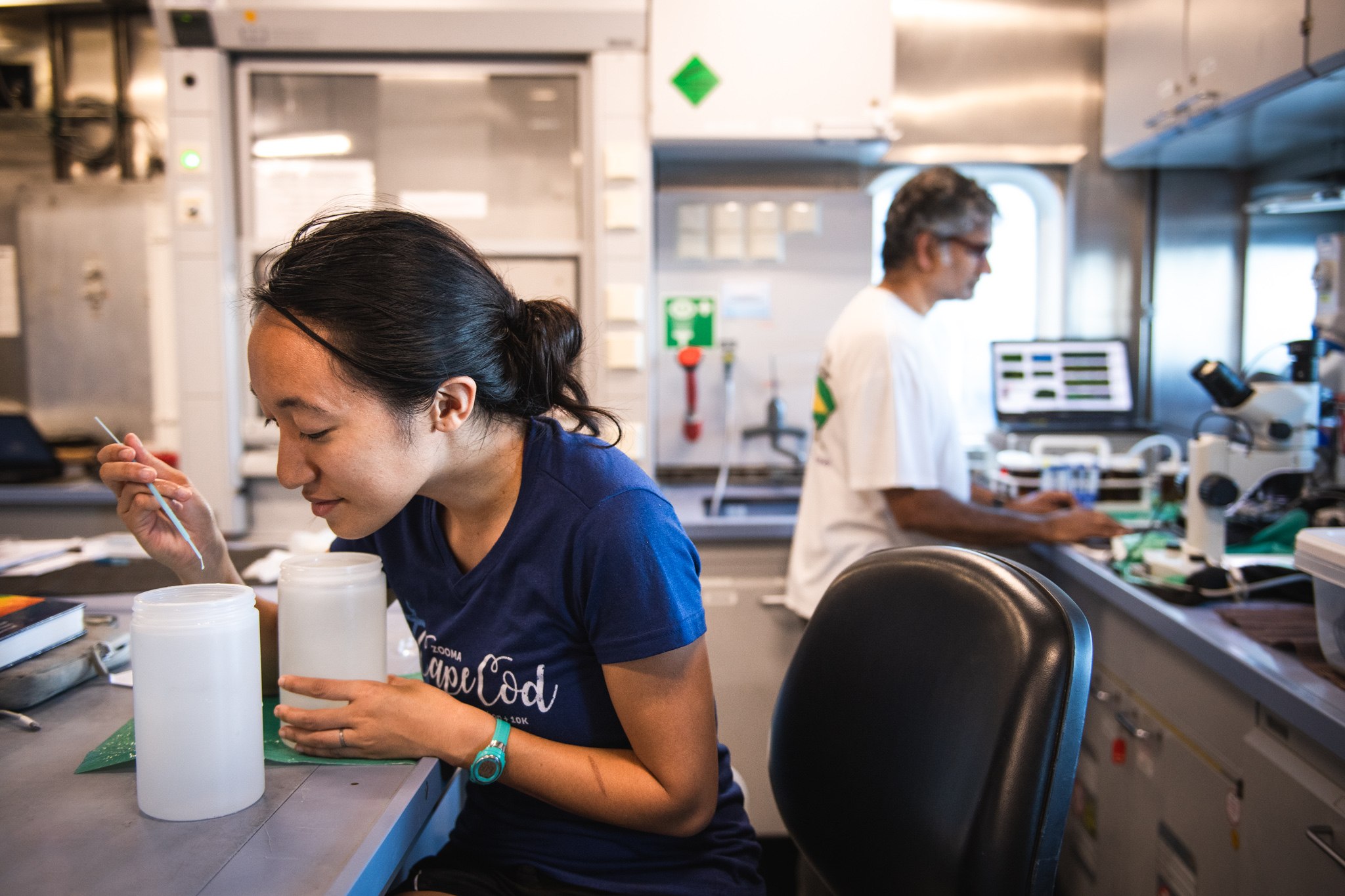
In the Wet Lab, we filter water to understand how particles and dissolved materials absorb light. After filtering water obtained from various depths using Niskin bottles attached to Falkor’s CTD (Conductivity, Temperature, and Depth rosette sampler) and the catamaran, we measure the absorption of our samples on a spectrophotometer, an instrument that measures the absorbance of light at different wavelengths. A few days ago, we filtered water from a fresh Trichodesmium spp. slick and observed a pink hue from phycoerythrin. Phycoerythrin is a light harvesting pigment found in Trichodesmium and other cyanobacteria.
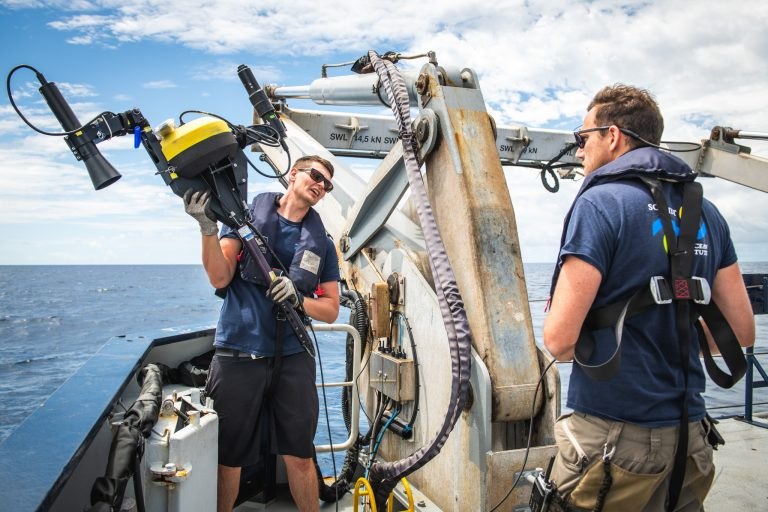
The remaining colors not absorbed by particles and dissolved materials in the water are scattered in different directions. The light that is scattered back to the surface is the reflectance that can be measured from UAVs and satellites. On the Falkor, we measure reflectance with profiling, floating, and hand-held radiometers. The profiling radiometer measures changes in light at 14 wavelengths from 380 to 705 nm with depth while the floating radiometer measures changes in reflectance due to light leaving and entering the sea surface. We also use hand-held radiometers that measures the reflectance changes due to sunlight and skylight bouncing off the sea surface. The collection of these reflectance measurements helps us ground-truth UAV and satellite reflectance measurements. Ultimately, pairing the absorption and reflectance measurements helps us develop bio-optical algorithms to detect Trichodesmium spp. blooms across ocean color imagery.
Your Water?
You can measure water color too! CyAN, Hydrocolor, and Eye on Water are free phone-apps you can measure water color properties using the camera on your phone, and you can compare your phone estimates with publicly accessible satellite images from NASA, NOAA, and USGS. Have fun learning about your water’s many colors and what may be present in the waters around you!