
Ridge Jumping
The members of the second student cruise met the small boat Atreyu at the University of Hawaii's Snug Harbor facility on a gray Easter afternoon.



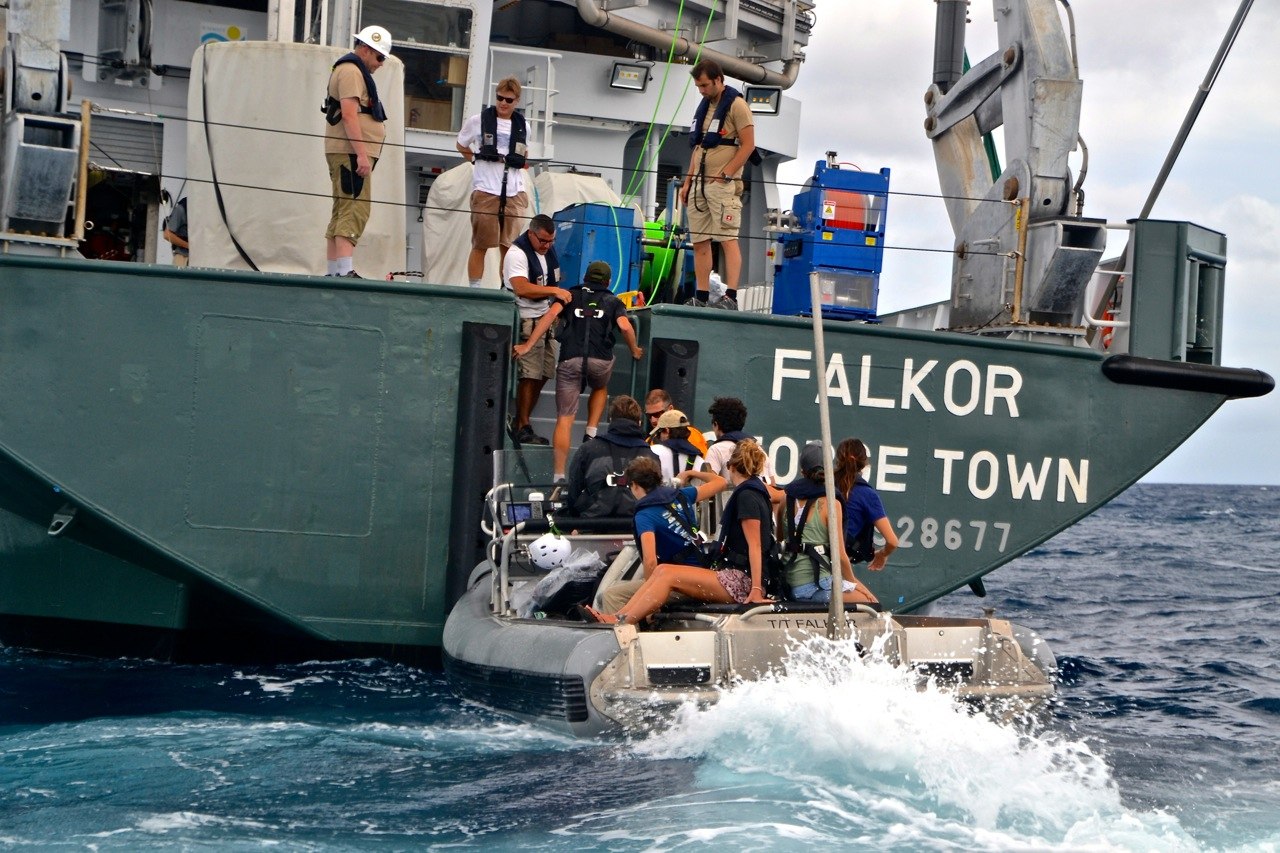
We dropped our duffels and backpacks wrapped in plastic garbage bags into the bottom of the jet boat and powered out through the sea spray to meet Falkor waiting outside of Honolulu Harbor.
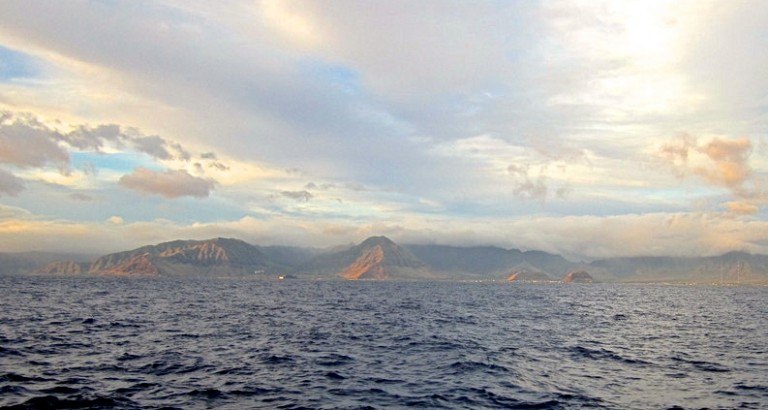
Onboard the crew was finishing up a rapid cabin changeover, and handing out room assignments to the new arrivals. We relaxed for about an hour as the captain navigated the ship west along the southern Oahu coast, rounding Barbers Point and continuing north towards the Kauai Ridge off of Kaena Point, Oahu.
Over Easter dinner, the recruiting quietly began. “Florian, you have an engineering background, right?” chief scientist Glenn Carter
The profiler itself is used to measure turbulence, and will be deployed off Falkor at different times during tidal cycles to map small-scale current fluctuations. As for the temperature sensor, its original metal bracket had been lost at sea with another device during an earlier cruise, so Florian used only the tools and materials available in Falkor’s drawers to assemble an admirable substitute.
The crew dropped the CTD rosette
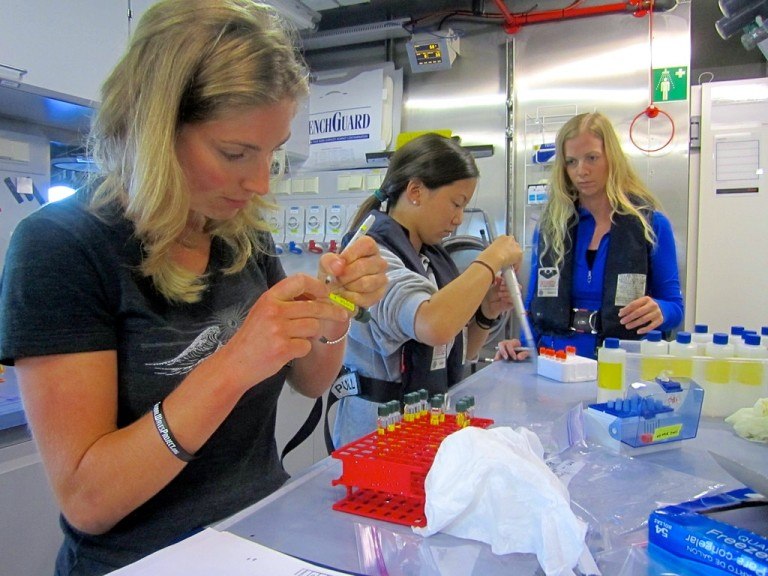
To keep the process moving, students man the radio in shifts, communicating with the winch operator controlling the CTD’s depth. “Operator, this is science control,” said Ted Conroy as data streamed across the panel of computer monitors, “Haul in at 30 meters per minute.” Ultimately the students log all the information collected on a uniform data sheet.
During this segment of the student cruise, our focus is internal tides off the western tip of Oahu. An internal tide is a wave formed below the sea surface by the turbulence generated as normal tides move water up and down slopes such as those at the base of our Hawaiian island.
We are focusing on Kauai Ridge because the effect is particularly pronounced in this area. Something of particular interest for the team is that during a previous cruise to this area researchers observed a phenomenon called a hydraulic jump.
In a hydraulic jump, the internal tide drives colder, denser water up over the ridge. Once over the ridge crest, gravity accelerates this water into a thin layer. This flow slows dramatically, and then the layer thickens dramatically or “jumps” up.
We will go into greater detail on how to visualize this jump—and the many effects that the associated turbulent mixing can have at the ridge—in future posts.
