



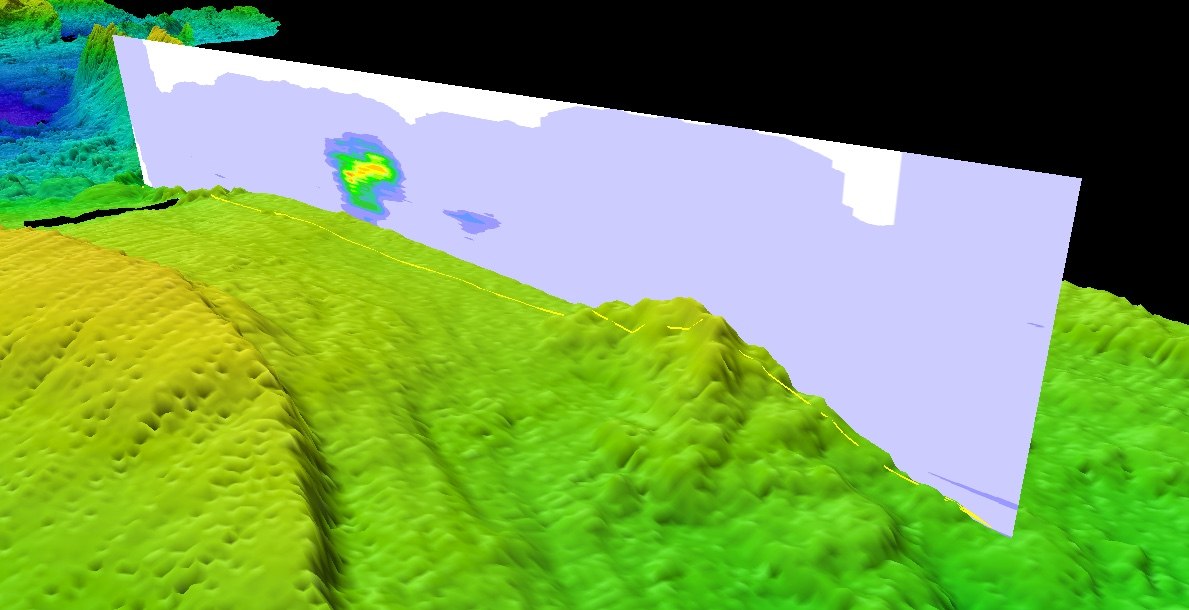


During the Hydrothermal Hunt, we have been searching for new hydrothermal vents in a vast unexplored stretch of the Mariana Back-arc, a zone where we know submarine volcanism
And the Winner is…

But how does the Segment 8 plume compare to the others we’ve found during this expedition? It was a big one, with strong signals from both chemical and optical sensors (suggesting an high-temperature vent field), but it was not big enough to de-throne our previous leader. Now that we have surveyed all the 10 back-arc segments, we can now announce that the winner of the “biggest plume competition” is... Segment 10
The discovery of a hydrothermal plume at Segment 8 adds to our total for the cruise. Overall, we have discovered four new hydrothermal vent sites, and at one of them we found that at least some of the venting was coming from a recently erupted lava flow! That lava flow is the deepest historical eruption yet discovered (at 4100-4450 m), and the first to be documented on a slow-spreading ridge. In addition, we were able to map the previously known Alice Springs hydrothermal site (on Map 10) in unprecedented detail with AUV Sentry. We are grateful to the captain and crew of R/V Falkor and the AUV Sentry team for all the fantastic support they have given us during this expedition. They have all been extraordinarily friendly, accommodating, and engaged in helping us accomplish our goals on this research cruise. We also greatly appreciate the NOAA Ocean Exploration and Research Program and NOAA’s Pacific Island Regional Office who supported the science on this expedition.
Our results from this cruise give us a set of great targets for next year, when we will return with R/V Falkor and a remotely operated vehicle to make dives at these new hydrothermal sites. We will then be able to see what they look like on the seafloor, take samples of the vent fluids for chemical analysis, and determine what animals and microbes are living at these new back-arc vents. This will allow us answer our “big picture” questions: are all the back-arc vents similar to each other geologically, chemically, and biologically? Do the same suite of chemosynthetic animals live at all the back-arc vents? How connected are the back-arc vents to one another? And how different are they from the better-known hydrothermal vents in the shallow volcanic arc? In the end we will have a better understanding of the global biogeography of vent organisms and their dependence on geologic and chemical environment.