The Climes They Are a Changin’
Having collected another set of data from our familiar C2 site, we are now steaming to a location a bit south of the A1 mooring.



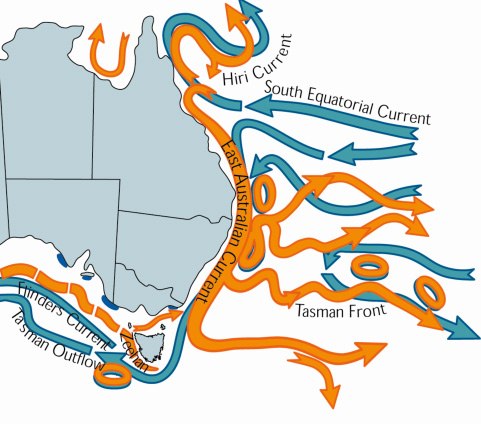
The East Australian Current (EAC) runs southward along the coast of eastern Australia, much like the Gulf Stream in the U.S. If the EAC sounds familiar, you can thank a little clownfish named Nemo
As we’ve mentioned before, eddies are an important element in understanding how the energy of the internal tide beam may be dissipated as it moves across the Tasman Sea, or as it is reflected off the Tasman shelf. Circulating in either clockwise or counterclockwise directions, the eddies create shear that can disrupt the low mode internal wave into higher mode waves (with smaller amplitudes), which don’t propagate as far. So, just as the internal tide can affect climate models by contributing to the movement of ocean energy around the globe, so might climate change impact how the internal tide moves that energy by gradually increasing eddy formation in the Tasman Sea. In their efforts to understand how the internal tide system works under current ocean conditions, T-Beam scientists are planning to collect more information on how eddies interact with the internal tide. Perhaps these data may eventually help them also predict how this system could be affected by ongoing changes in the EAC and regional climate.