
Using Nebula to Solve Nebulous Problems
Out here in the Tasman Sea, chasing the internal tide involves a lot of detective work, piecing together clues from water velocity, temperature, and density to determine where exactly the tide beam is heading.



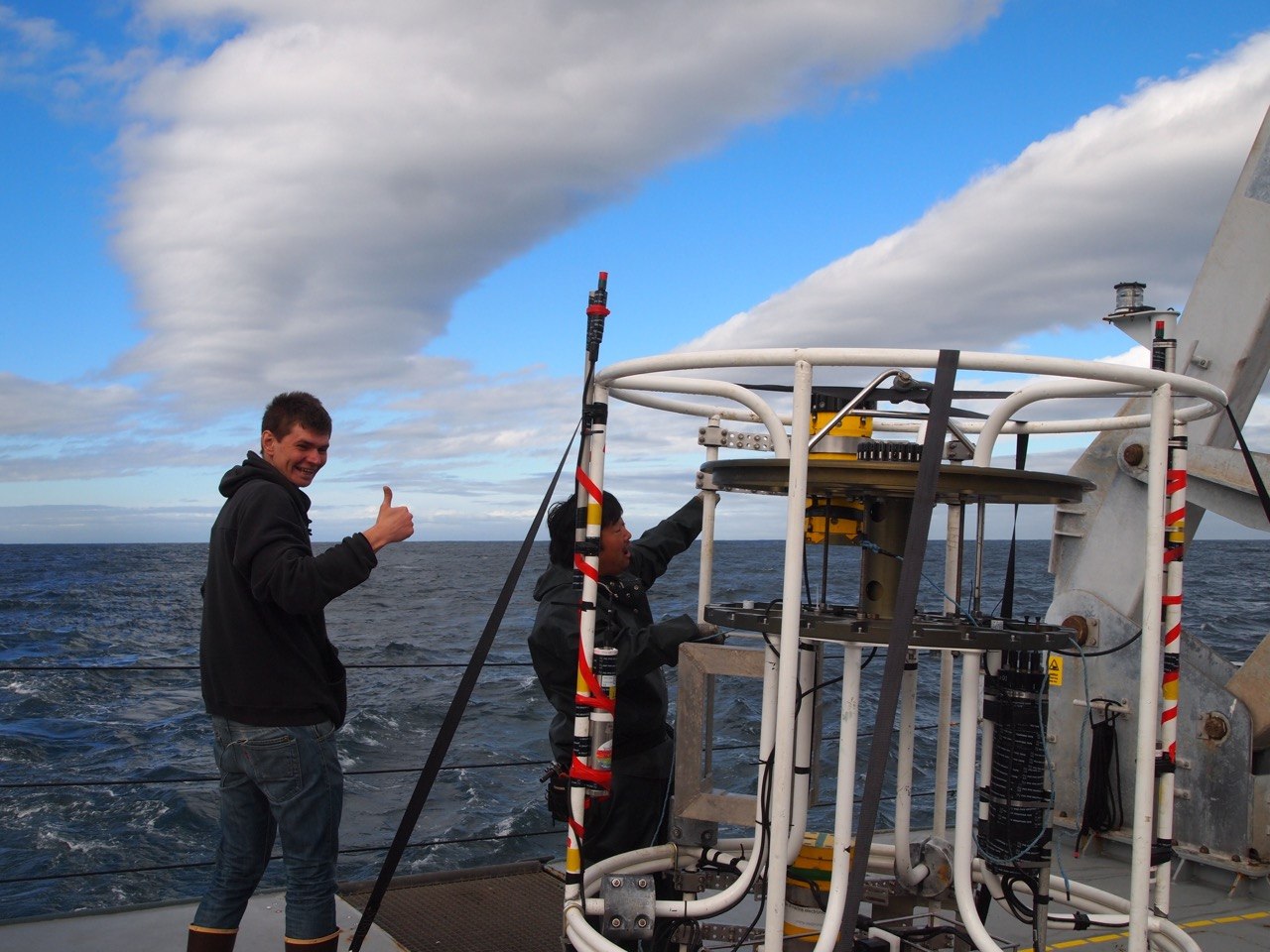
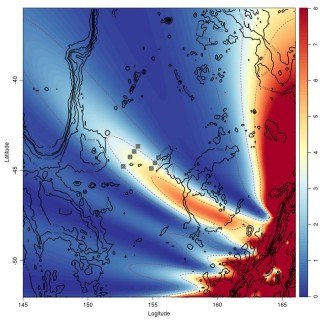
This is where mathematical modeling is again helpful. Modeling allows scientists to create a visualization of a complex phenomenon that integrates multiple sources of data with theoretical physics. The current state of the art model to describe ocean circulation, including internal waves, is called the MITgcm model (created at MIT in Boston, MA). On board Falkor, Dmitry Brazhnikov is using this model to generate a hypothesis that will describe the pathway of the T-Tide beam after it is generated on the Macquarie Ridge. Having an accurate picture of the direction of the beam is very important for understanding how it will interact with and reflect off of the Tasman Continental Slope. Starting with the satellite altimetry data to define one geographic section (domain) of the beam, Dmitry then began adding velocity and temperature data from this cruise into the model to re-prescribe the parameters of the MITgcm model to fit the specific conditions for the Tasman internal tide. This process is called data assimilation and is extremely useful for improving the accuracy of numerical models, and for exploring the behavior of a system/phenomenon when you don’t have the luxury of making direct observations on every aspect of it.
Although the weather has not been entirely cooperative, the T-Tide science team have still been able to collect a good amount of velocity and temperature data that offer a glimpse of where the T-Beam is. As we mentioned previously
None of these simulations would be possible during the course of a research cruise without the help of a “supercomputer”, which is essentially a computer with very high computing power and processing speed. This cruise, the T-Beam team is fortunate to be able to use the Nebula
