



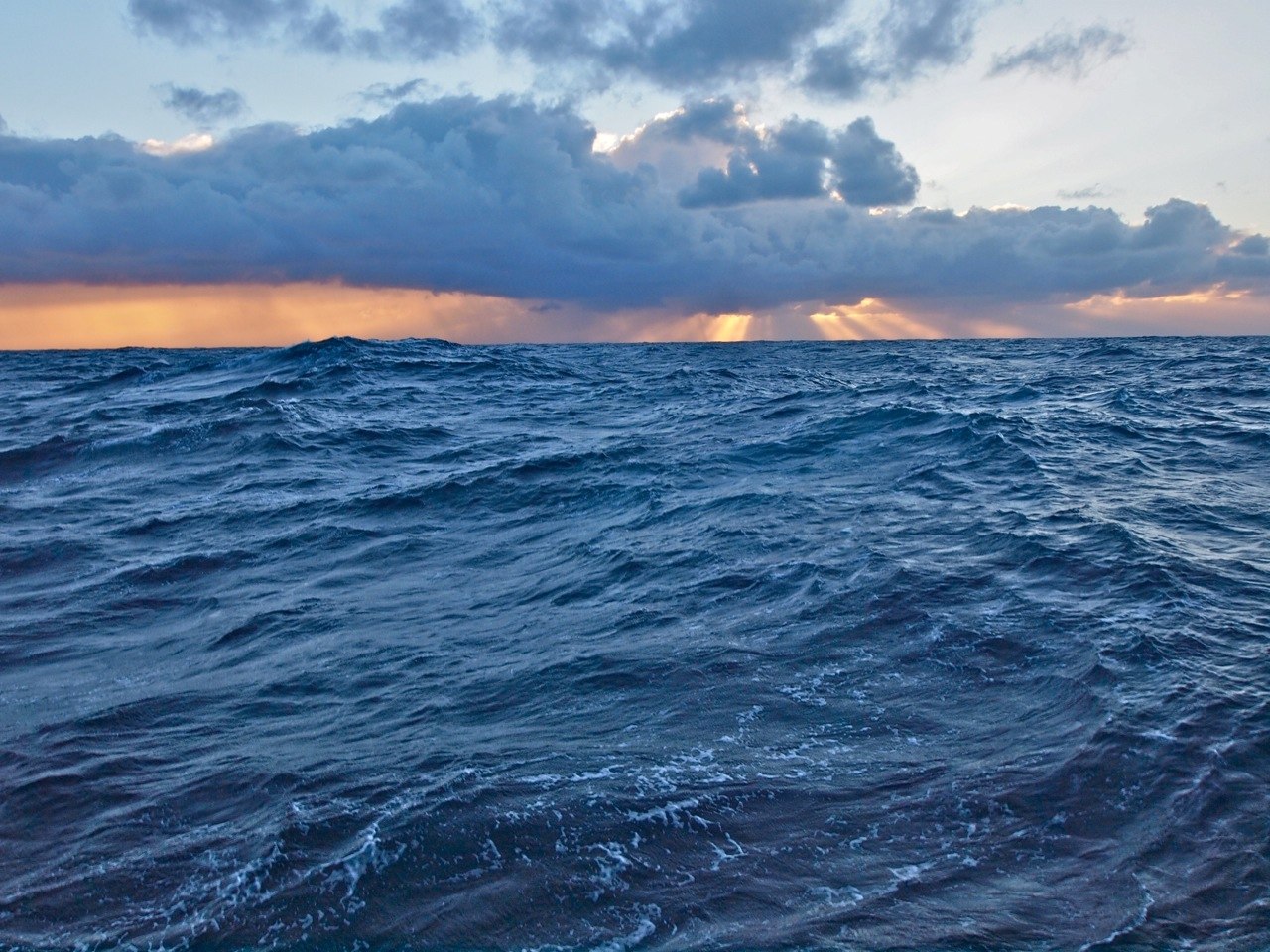

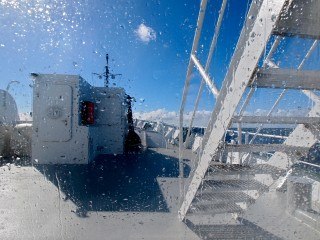
After a very rough ride, we arrived on station at 6 a.m. today, but weather conditions remained too poor to dive. Our science party is getting very antsy, as is the crew, but we obviously do not want to put the vehicle in the water if we cannot get it back safely.
So, we continue to wait, wait, and wait, and are working on being patient. As the mother of two young children, I am constantly being pushed to my limits of patience on land as well. At least ROPOS isn’t screaming at me while it tries to put on its shoes by itself for the 8th time as I’m scrambling to get it to daycare on time to make my 9 a.m. meeting at the lab.
Deep Conversation
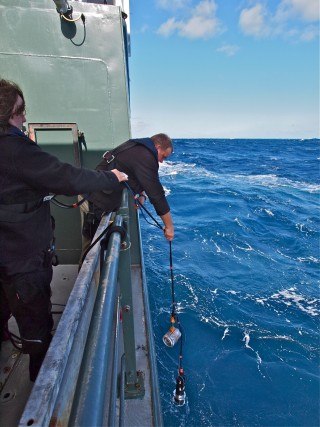
Here’s how we spent a day too rough for an ROV dive. Our colleague, Dave Dyer at the Applied Physics Laboratory at the University of Washington, recently installed some energy-harvesting “vent cap” devices that sit on top of a few active vents at Axial Seamount
In the afternoon, Giora Proskurowski gave a science talk to the crew about the cabled observatory being built at Axial Seamount
Axial is one of the best studied underwater volcanoes in the world, which makes it a great place for us to test some very specific hypotheses about carbon, microbes, and viruses. We hope to one day build an instrument for that to integrate with the cable, but first, we need to get some laboratory experimentation done. In the meantime, we wait, wait, and wait some more. The next weather check is at 6 a.m. Our fingers are crossed.