Dive In
The Mission
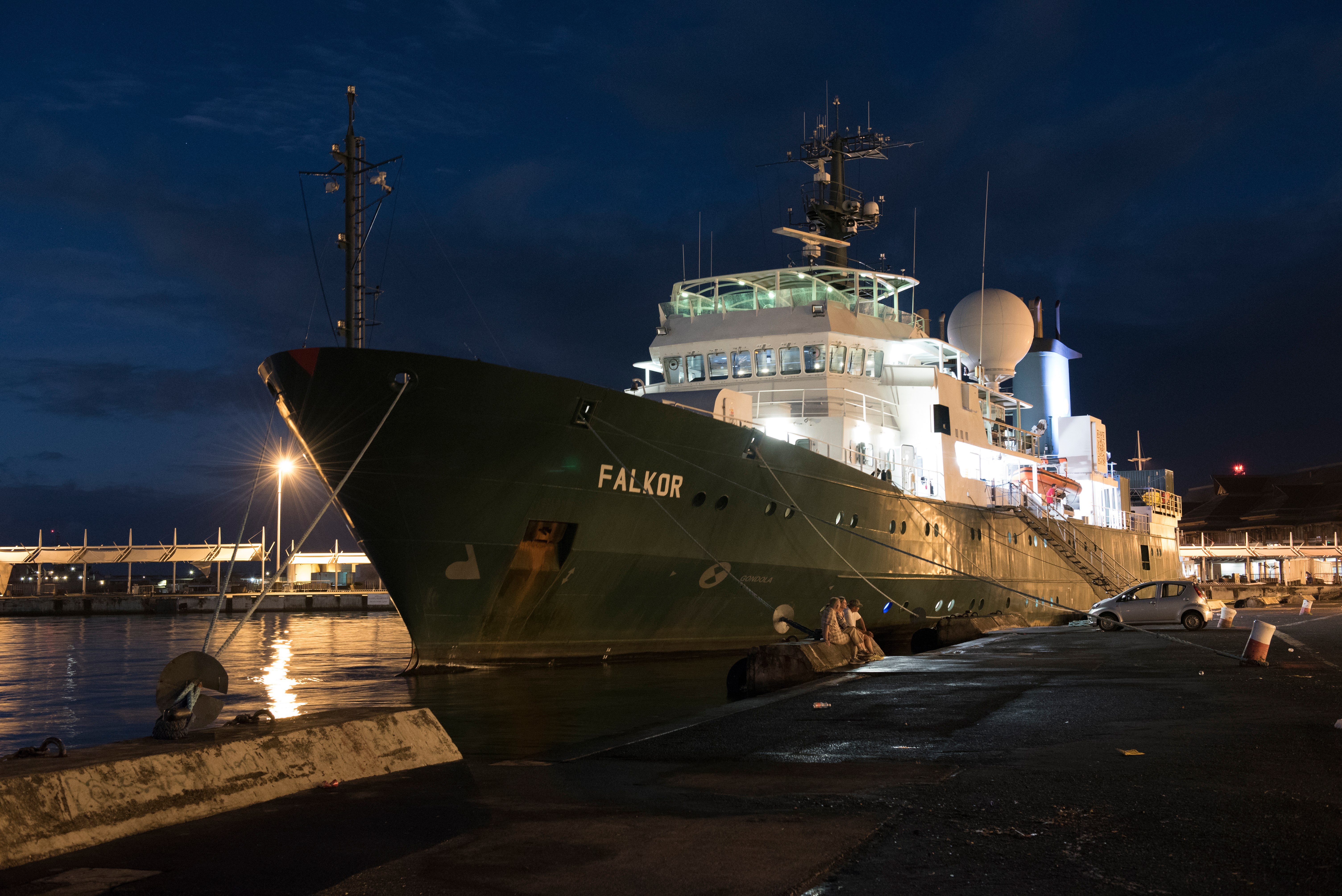
This February, R/V Falkor will sail to a remote area of the South Pacific Ocean, near Tahiti – pretty much at the very heart of the South Pacific Ocean and equally distant from the surrounding continents of North and South America, Asia and Australasia. The specific focus of the cruise is a geologic feature known as the Society Islands hot-spot trace.
A hot-spot trace is a chain of volcanoes formed by the movement of the earth’s crust over a rising jet of hot mantle rising from deep within the Earth: imagine what would happen if you slid a sheet of metal, horizontally, over a laser beam that was being pointed straight upward and you would get a good idea. These types of geological formation can be found in a few locations across the Pacific – the Hawaiian chain is a particularly good example that has already been studied extremely thoroughly. By contrast, the Society Islands hot spot trace in the remote South Pacific has been much less explored – there isn’t even a proper map, yet, to work with! Accordingly, Dr. Christopher German from the Woods Hole Oceanographic Institution (WHOI), along with an international team of world-class scientists, will travel to Papeete, Tahiti, to investigate the active seamounts in this region, explore for sites of seafloor hydrothermal activity and, at any sites that they locate, seek to discover what unique animals may be living living there, where they have come from and, hence, glean new insights into how different species migrate throughout Earth’s deep oceans.
The Variety and Flow of Deep-Sea Ecosystems
What is known, is that there are volcanic seamounts south and east of Tahiti including at least one, Teahitia, that has erupted in the last 30 years. In late 2013, strong chemical signals were detected above Teahitia indicating that there are vents active at that site that were not present the last time anybody checked – but that was more than 20 years ago! Deep underwater, these hydrothermal vents are openings in the ocean’s floor where extremely hot and mineral-rich water flows out from beneath the seabed. The mixture of scorching chemical-laden geothermal fluids with the cold deep ocean releases energy that is captured and used to sustain unique ecosystems. Wherever new vents are discovered in Earth’s ocean basins, new forms of life are discovered too. Because this expedition will aim to explore and locate sites of seafloor hydrothermal activity in a place that is particularly geologically remote from all other known vent-sites, we predict that the biological discoveries we make may also be quite unlike anything we have seen before – but we won’t know until we get there!
While the primary motivations for our exploration are based in Geology and Biology, the key to how we plan to make our discoveries is through studying the Physics and Chemistry of the deep ocean studying features referred to as “Hydrothermal Plumes.” While the seafloor around Tahiti is volcanically active, the region, like any other volcanic system on land, spends most of its time in a dormant state rather than actively erupting. But that doesn’t mean there isn’t a lot of heat stored up just below the seafloor and when cold seawater percolates down through those cracks, it becomes superheated at the high pressures found one or more miles beneath the ocean surface and the resulting hot and acidic fluid then reacts with the surrounding rocks to dissolve up a range of minerals yielding a hot, and chemical-laden fluid that jets back out from the seafloor. Hydrothermal plumes arise when those high temperature fluids, which are extremely buoyant, mix turbulently, with the cold seawater that they are ejected into. The result is a rising column of rapidly mixing hot and cold liquids that as they cool and continue to mix, also generate a complex array of minerals which form as fine grained particles that are swept up by the currents rather like a smoke stack above a factory chimney. Hence, the common name applied to many seafloor vent-sites: Black Smokers. By detecting the presence of these plumes (which can spread for miles through the oceans) and following their chemical signals upstream through the oceans (rather like panning for gold, working your way up a mountain stream’s bed) it is possible to locate new vent-sites, which may take up no more space than the size of a house or a single room in a house, on the deep remote seabed.
Where discovery of hydrothermal vents can become particularly rewarding is at the cross-over between the Earth Sciences and Life Sciences. Because while hydrothermal venting can be thought of as an entirely geologically driven process, the chemical reactions that result can lead to the sustenance of a completely new form of life, independent of sunlight (the photosynthesis that we are most familiar with) which, because it is driven by chemistry, we term chemosynthesis a process by which microbes convert the carbon, primarily from CO2 in the oceans, into complex organic matter to feed both themselves and, often, the complex larger animals (e.g. tube works, shrimp) that host them.
Through such symbioses, entire ecosystems can be formed, in the absence of sunlight, in ways that scientists generation ago thought impossible.
An untapped underwater laboratory
The southeastern limit of the Society Islands hot-spot trace is an area that has been largely overlooked when it comes to hydrothermal exploration and discovery. This is not surprising given how isolated the Society Islands are in the middle of the South Pacific. Looking at a map, this area is as far as you can get from any continental land mass, as well as any known vent-sites worldwide. In fact, no new vents have been discovered anywhere in the Central Pacific for over 20 years.
Wherever new vent-sites are found, new animals and sometimes even entire new biogeographic provinces are located. Over the past 20 years or so, Principal Investigator Dr. Chris German has been working with co-Principal Investigator, Dr. Cindy Van Dover from the Duke University Marine Lab to better understand what controls the biogeography of the vent ecosystems. While their explorations, dating back to the 1990s, have now shown that hydrothermal vents can exist all over our planet (that didn’t used to be the accepted norm), scientists still are not sure why the animals living at these vent systems are not the same worldwide. After all, we know that the entire deep ocean gets thoroughly mixed every 2000 years so how come the animals living at the vent sites are not more similar throughout the deep ocean? On this expedition, Dr. German and Dr. VanDover will seek to capture the first photographs of vent-communities on the seafloor as a first peek into how the Society Islands’ mega faunal communities are related to the major biogeographic provinces identified at other previously known vent sites in the North East Pacific off the US, in the Central and Southern East Pacific from Mexico down to Chile and in the Western Pacific from New Zealand up to Japan.
On a previous expedition that ran from October to December 2013, from Peru to Tahiti, Dr. German tracked chemical staining from hydrothermal vents situated in the SE Pacific off Peru for more than 4000 km, all the way West as far as Tahiti. If chemical signals can get that far, then what Dr. German and the science team want to know now is if the larvae of vent-animals can survive over a journey that lasts that far and that long (perhaps a 50 year transit?) as well.
Exploration of unknown vents
Dr. German and his team know of nine seamounts waiting to be explored in this region, any of which may be hydrothermally active. The work will be extensive, following a series of carefully planned steps, each more detailed than the previous. While venting was located at the Loihi seamount off the SE edge of the Big Island of Hawaii in the 1980s, no comparable systematic and robotics-based exploration has yet been attempted at any other inter-plate volcanic system.
First, the scientists will use R/V Falkor’s high-resolution multibeam echosounder to map the seafloor - to ensure that no geological features are missed and to determine the precise shape of each seamount. This information will not only guide their location selection during the expedition, but will translate into better bathymetric charts to be used in all future investigations.
Once the summits of each seamount have been identified, the ship’s CTD-rosette system will be lowered to depth right over the summit. Using in situ chemical sensors coupled with sampling at different depths for shipboard chemical measurements, the team will determine which of the seamounts do, or do not, show evidence for active hydrothermal venting.
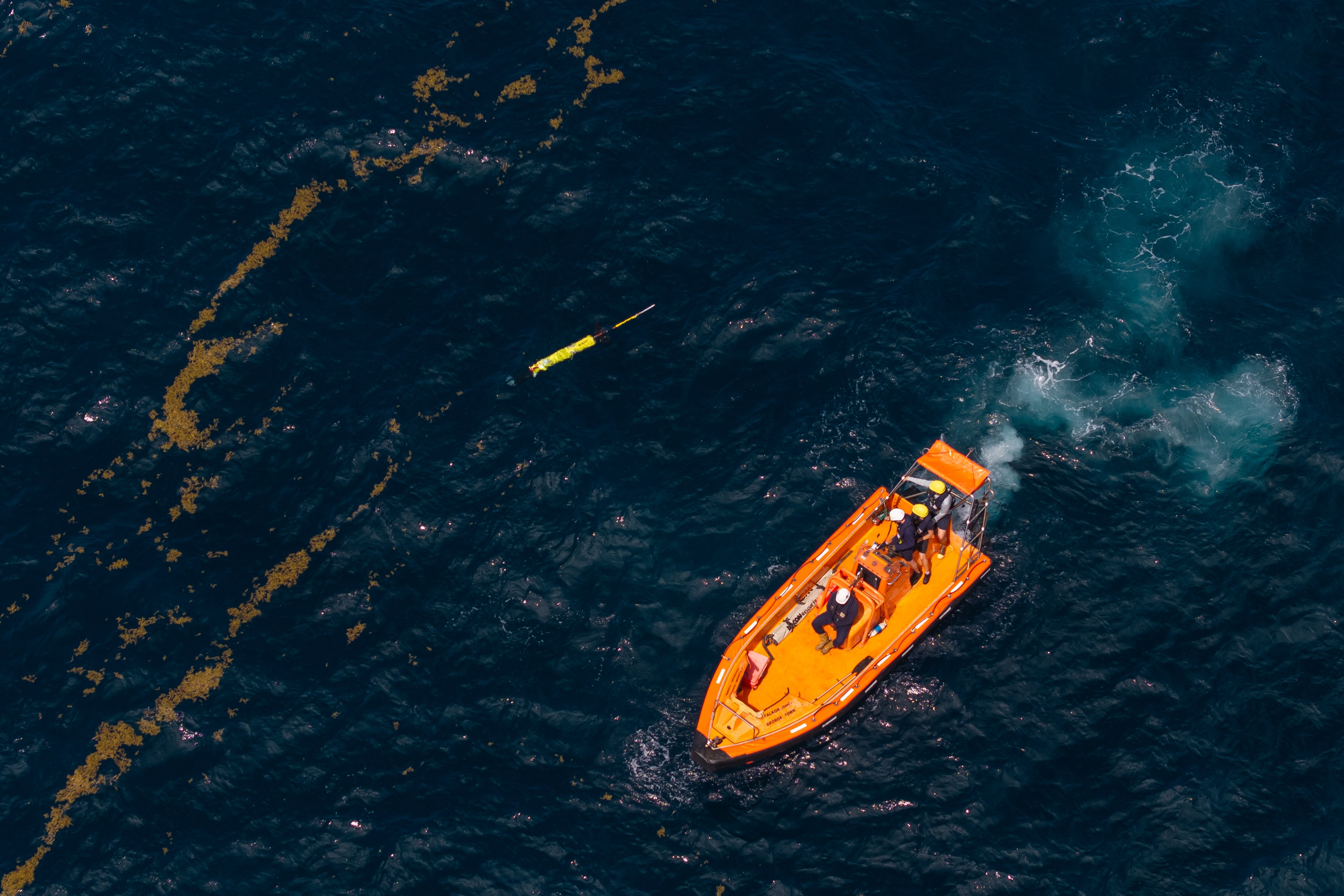
At any sites that do show characteristic hydrothermal plume signals, starting with Teahitia Seamount, the team will conduct a series of surveys using the Autonomous Underwater Vehicle (AUV) Remus to conduct three sets of nested surveys. First, we will map out the core of the plume from its chemical signals using in situ sensors that analyze the ocean’s composition on-the-fly. Next, we will conduct precise high resolution mapping of the seafloor beneath any areas where the plume’s chemical signals are strongest because that will reveal where the AUV passed closest to the hydrothermal vent source. This mapping is important because it will allow us to determine the size and shape of both the steep and rocky seamounts but also the hydrothermal fields themselves which might include chimneys that stick up another 10m or more above the seabed. Once we have those ultra-high resolution maps available we will then conduct the trickiest part of the expedition yet, programming the AUV to fly in close above the seafloor (keeping just above those collision-hazard chimneys!) to photograph the geology of the seafloor, including the vent-sites, and – finally – to determine the abundance, community structure, and distribution of any chemosynthetic ecosystems that they host. Once we have completed all the above, at any given vent sites, we will end with one or more CTD casts directly above each vent-site to collect highest possible quality samples for geochemical analysis and archiving and, if the vents are found on any of the shallowest seamounts that we will be investigating, in less than 300m depth, we will also have the opportunity to dive on them using the RV Falkor’s 300m-rated SAAB Remotely Operated Vehicle (ROV) which will also allow us to broadcast our exploration live to shore via the internet.
High risk, high reward
This vent exploration of the remote Society Islands is unprecedented. The team is confident that this will be a rewarding expedition that may well lead to the discovery of new vent sites, novel species and even a new biogeographic province. “I wonder what is living there today”, asks Dr. German, “and what that can tell us about how fast a vent site can get colonized out in the middle of the wide ocean?”