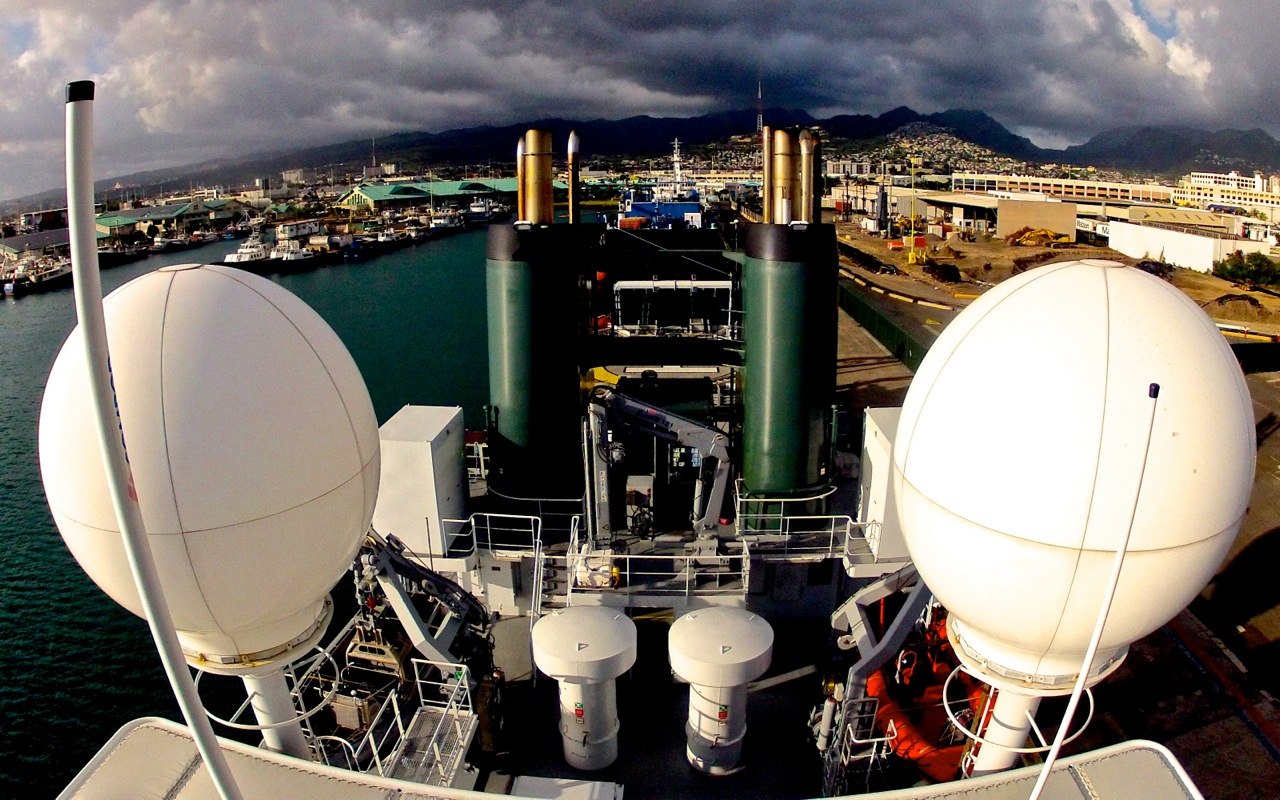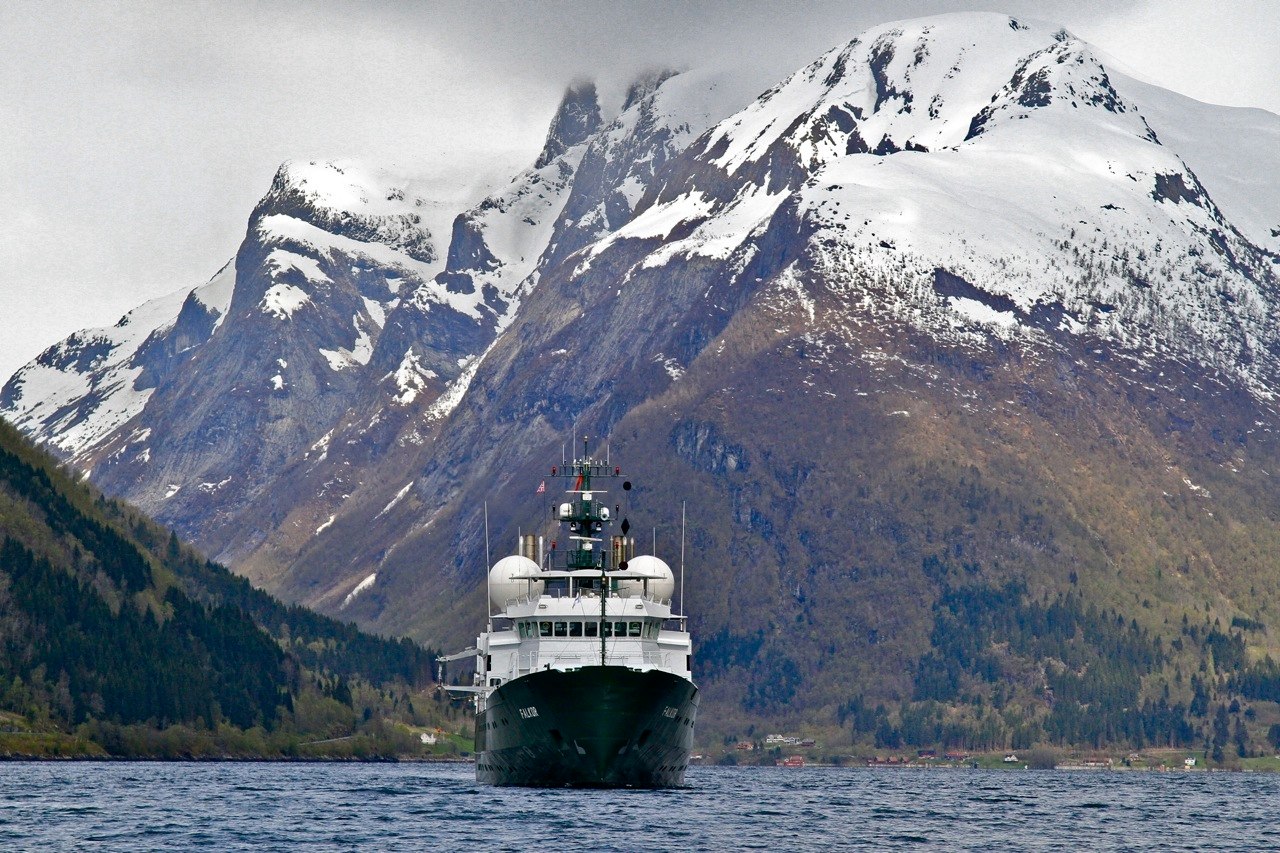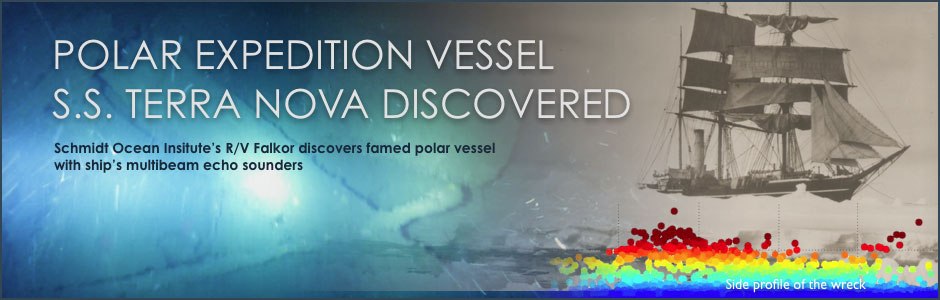

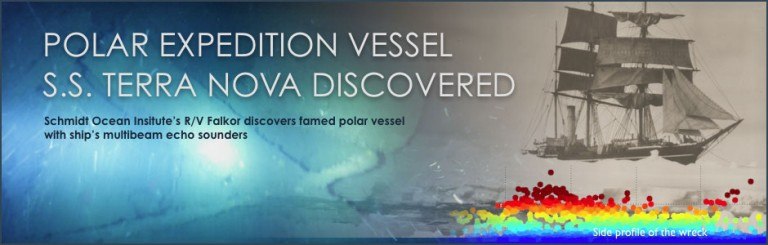
August 13, 2012—Last month, during routine functional performance testing of the mutibeam mapping echosounders on the Schmidt Ocean Institute’s flagship R/V Falkor, the team aboard—including researchers from the University of New Hampshire, Ifremer, and Woods Hole Oceanographic Institution—discovered the S.S. Terra Nova, a whaler, sealer and polar exploration ship that sunk off the southern coast of Greenland in September, 1943, after being damaged by ice.
The performance verification of R/V Falkor’s scientific echo sounders precedes oceanographic research cruises set to begin in 2013. The tests included a shallow water survey off the southern coast of Greenland to assess the Kongsberg EM710 multibeam mapping echo sounder’s performance in complex topography. The testing took place on July 11, 2012, as part of the planned R/V Falkor field trials during the transit of the vessel from Newcastle, UK to Nuuk, Greenland.
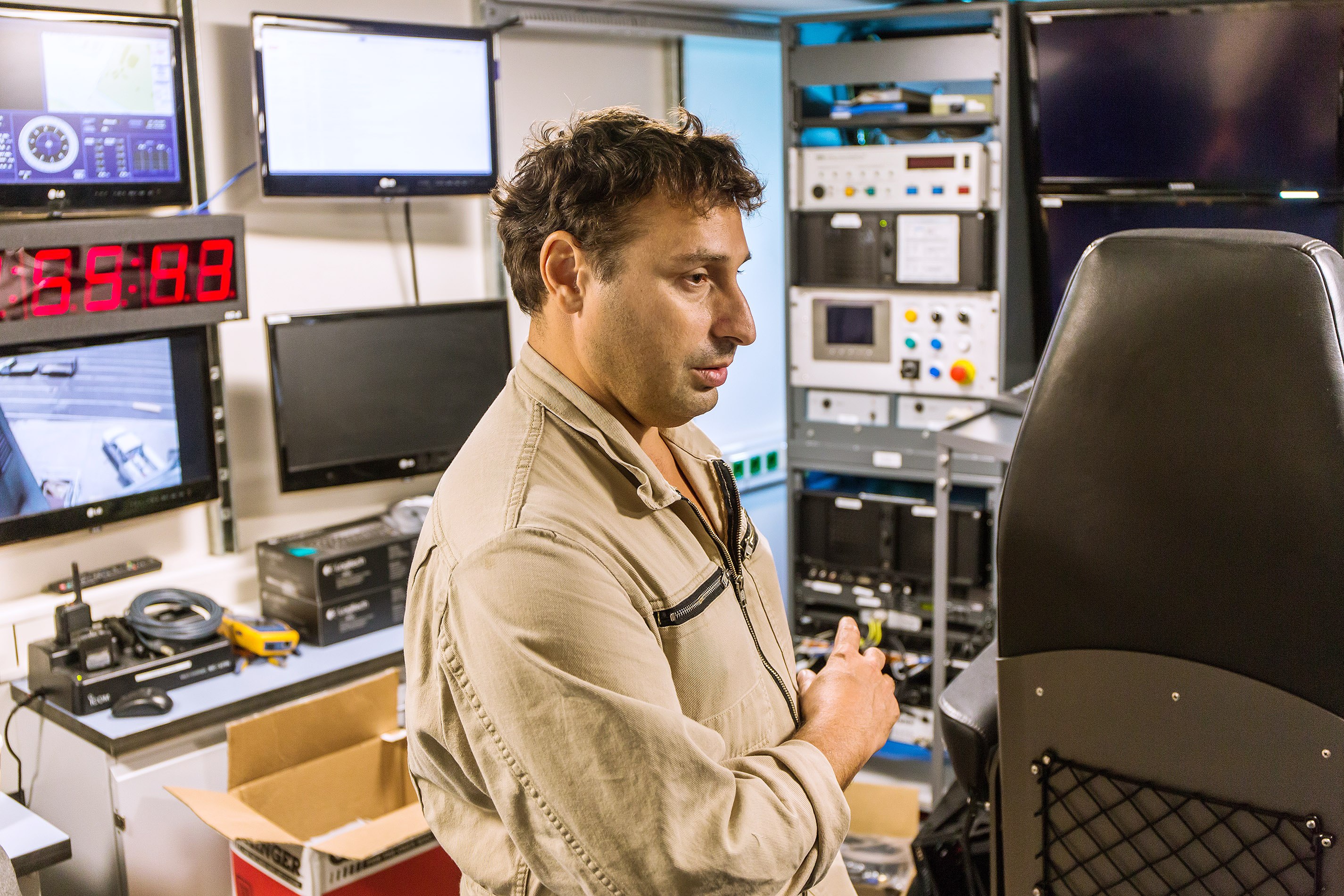
Researchers selected the test survey site for several reasons: It allowed testing of ship's mapping capabilities at seafloor depths between 10 and 1800 meters, and the glacial activity in the area created distinct and prominent seafloor features. Because of the glaciers, the Schmidt Ocean Institute survey team expected to see mixtures of deposits from soft sediment to gravel and boulders deposited by icebergs and glaciers. Different seabed compositions enable testing of the reception quality of the high/low back scatter signals by the multibeam system. Icebergs common to the area leave significant gouging marks on the seabed, which would effectively test bathymetric mapping data. In addition to meeting all of these criteria for the test site, the region was also familiar to Schmidt Ocean Institute Marine Technician Leighton Rolley, who had read that the polar exploration vessel S.S. Terra Nova was reported lost off Southern Greenland in 1943. With all the topographical considerations and with the secondary possibility of using a wreck as a calibration reference for the sonar equipment, the Schmidt Ocean Institute had prioritized this location as the optimal spot for this round of tests. Approximate estimated position of the wreck was used as the central point for the test survey. An area roughly five nautical miles around this position was selected for the survey to encompass various features, shallows and slopes necessary to evaluate the sonar performance. As a result of the survey, the chosen area yielded excellent topographical data that enabled comprehensive verification of the EM710 performance. The bathymetric data produced by EM710 during these sonar trials was of very high quality, substantially exceeding expectations. All members of a collaborative group of sonar experts from Schmidt Ocean Institute, University of New Hampshire, and Ifremer who were present on-board to evaluate the systems operational capabilities were satisfied with the outcomes of the sonar trials. As anticipated, numerous iceberg strikes and gouges were observed on the seabed along with striking features not listed on the existing nautical charts. The contrast between hard and soft sediment signatures exceeded expectations. Gullies and gouges had collected soft sediment, while the surrounding flat seabed consisted largely of gravel and coarse material deposited by icebergs and glaciers with clearly contrasting backscatter. On the first line of the calibration survey, on-board survey expert Jonathan Beaudoin from the University of New Hampshire had noted a feature on the seabed which remained initially unidentified. Upon completion of the main calibration exercise, SOI technician Leighton Rolley and Jonathan reviewed each of the many potential targets identified during the 12 hours of surveying, and the target was noted as a strong candidate for further investigation. Multibeam data expert Jean Marie from Ifremer analyzed the feature in more detail, finding its length (57m) to match the reported length of the Terra Nova.
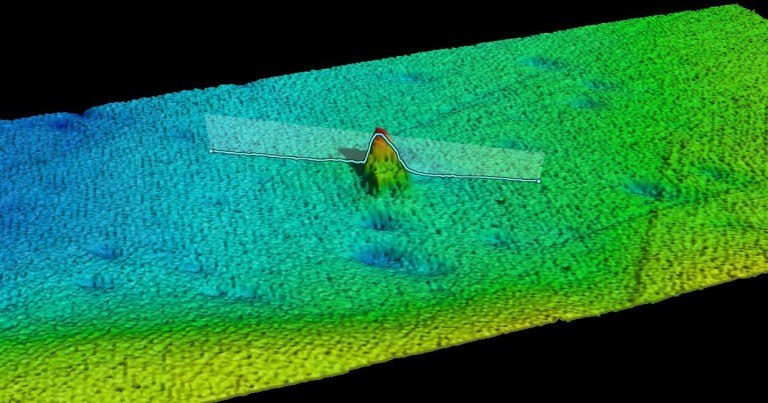
Encouraged by the similarity in length, the acoustic survey team post-processed the collected multi-beam data to verify the observed feature. A shorter survey from several angles reaffirmed the possibility that the team had found a wreck. During the earlier stages of the transatlantic cruise, the Schmidt Ocean Institute marine technicians had an opportunity to develop a weighted camera package to film the plankton net trawls conducted by scientists aboard R/V Falkor from Woods Hole Oceanographic Institution. This footage was designed for community outreach work to show how these nets capture plankton which our scientists then study.
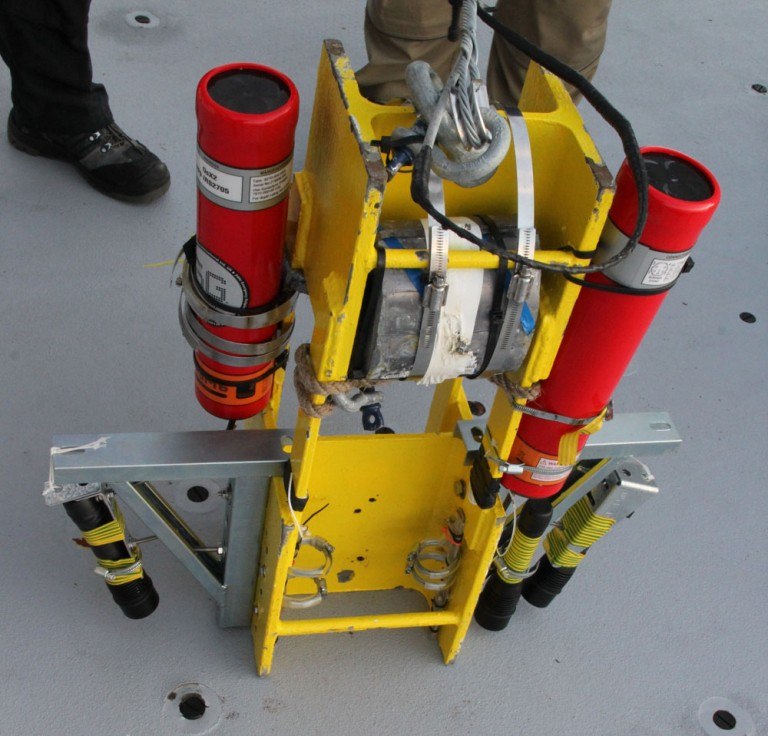
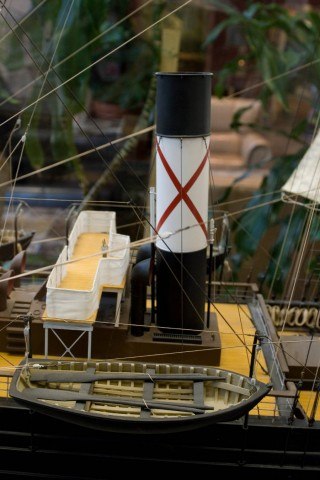
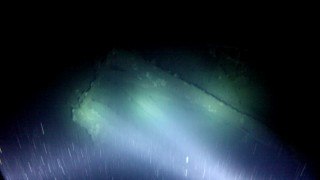
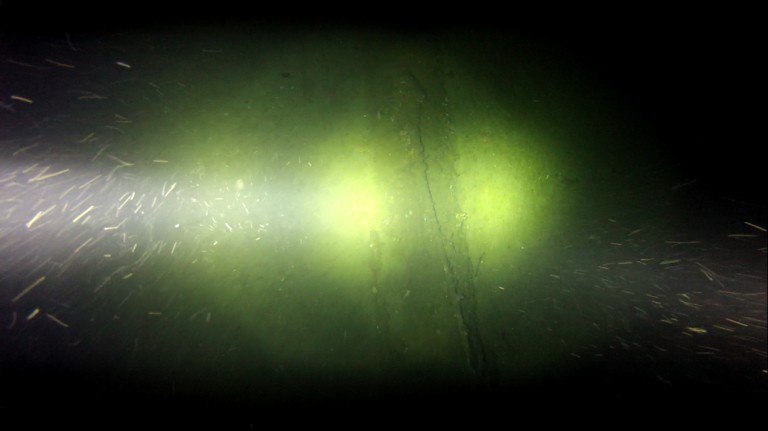
This camera package (Simple High Resolution IMaging Package, or SHRIMP), a solid metal frame with two attached cameras and three to four dive flashlights for light to document the planned plankton net tows. As the observed feature lay within the depth range of the SHRIMP, the Schmidt Ocean Institute team decided to use the camera to take a closer look. https://youtu.be/Bar1jMJv_Rw The package dropped to a position just above the target to help identify the nature of this 57 m long feature observed in the EM710 output mapping data. Camera tows across the top of the target showed the remains of a wooden wreck laying on the seabed. The camera footage also identified the funnel of the vessel, next to the wreck. The forecastle of the vessel appeared to be “peeled” upwards to the port side and at an angle from the rest of the ship. The team compared the funnel image with historical photographs of the S.S. Terra Nova. All observations jointly identified this wreck as the sunken S.S. Terra Nova. https://youtu.be/U3QXVDsZR6Y The discovery of the lost S.S. Terra Nova, one of the most famous polar exploration vessels, was an exciting achievement—in addition to serving to successfully verify the performance and operational condition of the Schmidt Ocean Institute's R/V Falkor multibeam echo sounders. The discovery was made possible thanks to the collaborative and exhaustive efforts of all those onboard. Schmidt Ocean Institute offers its profound thanks to the sonar experts and scientific representatives from the University of New Hampshire, Ifremer, and Woods Hole Oceanographic Institution for their excellent support throughout this cruise.
Regarding the wreck location:
S.S. Terra Nova was discovered during the testing of R/V Falkor scientific multibeam echo sounders. The permit for the instrument testing off the southern coast of Greenland was issued to the Schmidt Ocean Institute by the United States Department of State. When the permit was issued, the U.S. Department of State requested that the Schmidt Ocean Institute does not release information about any possible wreck discoveries that may occur as a result of the sonar testing unless authorized to do so by the U.S. government. In compliance with this requirement, upon the discovery of the wreck, Schmidt Ocean Institute first informed the U.S. Department of State. Following consultations with the appropriate authorities in the United Kingdom and Denmark governments, the U.S. Department of State authorized the Schmidt Ocean Institute to release the information about this discovery, as long as the exact location or depth of the wreck are not disclosed to protect the site of obvious historical significance from unwanted attention. Any requests to obtain the information about the exact location and depth of the wreck should be addressed to the U.S. Department of State or appropriate authorities within the United Kingdom and Denmark governments. Supplementary materials:Historical footage of S.S. Terra Nova returning to the UK after Robert Scott's expeditionDefinitive history of the S.S. Terra Nova by Michael C. TarverCoverage around the Web:Wreck of Captain Scott's ship discovered off Greenland - The TelegraphThe S.S. Terra Nova... has been found on the sea bed off Greenland - The CourierCaptain Scott’s ship found 100 years after South Pole trek - MetroScott's last command - The TelegraphScott’s lost ship, Terra Nova, discovered off the Greenland coast - explorersweb.comCaptain Robert Falcon Scott’s final expedition ship found after 69 years - scotsman.comCaptain Scott's Terra Nova found wrecked on sea bed - The HeraldScott's wrecked ship Terra Nova found off Greenland - BBC NewsTerra Nova wreck found off Greenland - The Sydney Morning HeraldCaptain Scott's ship Terra Nova discovered off coast of Greenland - Wales OnlineDiscovered! Captain Scott's ship Terra Nova reveals itself in north Atlantic - Daily RecordScott's ship found at bottom of sea - New Zealand HeraldFamed Antarctic Explorer's Ship Found ... Near the Arctic - NewserFamed SS Terra Nova Shipwreck Discovered Off Greenland - The Maritime ExecutiveRobert Falcon Scott's Terra Nova wreck found off Greenland - Perth NowResearchers find SS Terra Nova wreck off Greenland - PressTVTerra Nova Ship ... Found Sunk Off Greenland - redorbit.comWreck of Robert Falcon Scott’s Ship Terra Nova Discovered - History.comWreck of ship from famed expedition found - UPI.comShip linked to Captain Scott’s failed South Pole expedition found off Greenland - MercoPressDoomed Polar Explorer's Famed Ship Found on Seafloor - OurAmazingPlanetCaptain Scott's ship found off Greenland - ABC NewsTerra Nova found - The TelegramSalvage firm finds the ship that took Scott on his ill-fated Antarctic expedition - Daily MailResearchers Discover Century-Old Ship - French TribuneSS Terra Nova Wreck Found Off Greenland - Huffington PostFinal resting place of Scott's Terra Nova is found - This is CornwallScott of the Antarctic’s Ship Found - wales.comCapt. Scott's Terra Nova shipwreck found off Greenland - CBC NewsThe Terra Nova and Her Polar Adventures - PRI's theworld.orgLost Antarctic History Found off Greenland Coast - Discovery NewsRobert Falcon Scott’s Ship Found At Bottom Of The Ocean Near Greenland - The InquisitrTerra Nova Discovery - National GeographicShip that carried Capt. Scott discovered off Greenland 70 years later - Toronto StarLegendary expedition ship in search for South Pole found off Greenland - Fox NewsLegendary expedition ship found off Greenland - Miami HeraldRobert Scott's ship found after 70 years - News Track IndiaLegendary Antarctic expedition ship found off Greenland... - The Washington PostLegendary expedition vessel S.S. Terra Nova discovered off Greenland (+video) - The Petri DishCaptain Scott's Ship, The S.S. Terra Nova, Found Off The Coast Of Greenland - Latinos PostGreat Scott! Video Of Captain's Wreck Emerges - Sky NewsSS Terra Nova That Carried Explorer Robert Scott Found - WFMY NewsVideo of captain's wreck emerges - Sky News AustraliaTerra Nova Expedition Ship Discovered - GadlingSchip van poolreiziger Robert Falcon Scott gevonde - Telegraf.nlForscher finden Wrack von Robert Scotts Schiff "Terra Nova" - Spiegel.deRobert Scotts ”Terra Nova” funnen på havsbotten - DN.seRobert Scotts skip er funnet - nrk.noWreck of Scott’s polar ship found off Greenland - The History BlogInterview of Leighton Rolley for BBC Radio Wales (44:40 - 54:30)UNH Researcher Aids in Discovery of Shipwrecked Antarctic Explorer Terra Nova - UNH TodayUK Antarctic Heritage Trust Welcomes Terra Nova DiscoveryScotts ”Terra Nova” funnen - DYK | The Scandinavian Dive Magazine2012 in Review: 9 Important Archaeological (and Paleontological!) Discoveries