
A few days ago we invited anyone who was interestedWhat are the latest trends in global autonomous underwater robotics market?
Increased autonomy and building systems with multiple robotic agents.
What kind of organisms can be found specifically in cold seeps?
There are many chemosynthetic ecosystems found in cold seeps. These are based on bacteria that use the chemical energy of the environment to sustain themselves. These form the basis of the chemosynthetic food chain much like plants form the base of our. The ecosystem gets very diverse as you go up the food chain and many of the larger animals you see at these sites are things like tube worms and mussels.
What method of movement is efficient for an underwater robot, using propeller or using fish-like movements?
For the most part, a propeller. While biological tissue and motion is based on linear contraction of muscles, mechatronic systems are ultimately based on objects that spin around in circles. We can copy how animals move very well, but it is often less efficient because the fundamental way in which the actuation is achieved is not the same. However, there are some researchers looking at different ways of achieving the actuation, so who knows how things will change in the future.
What are the main types of cold seeps?
The main type is oil/gas. There are also gas/methane hydrates, mud volcanoes and brine seeps.
What are the differences between hydrothermal vents and cold seeps?
Hydrothermal vents emit fluids that are heated by geothermal activity. Cold seeps are typically created by trapped hydrocarbons that seep out of fissures.
What exactly are cold seeps?
Cold seeps are typically created by trapped hydrocarbons that seep out of fissures. There are different types of seeps oil/gas, gas/methane hydrates, mud volcanoes and brine seeps.
What are the different types of underwater robots in existence currently?
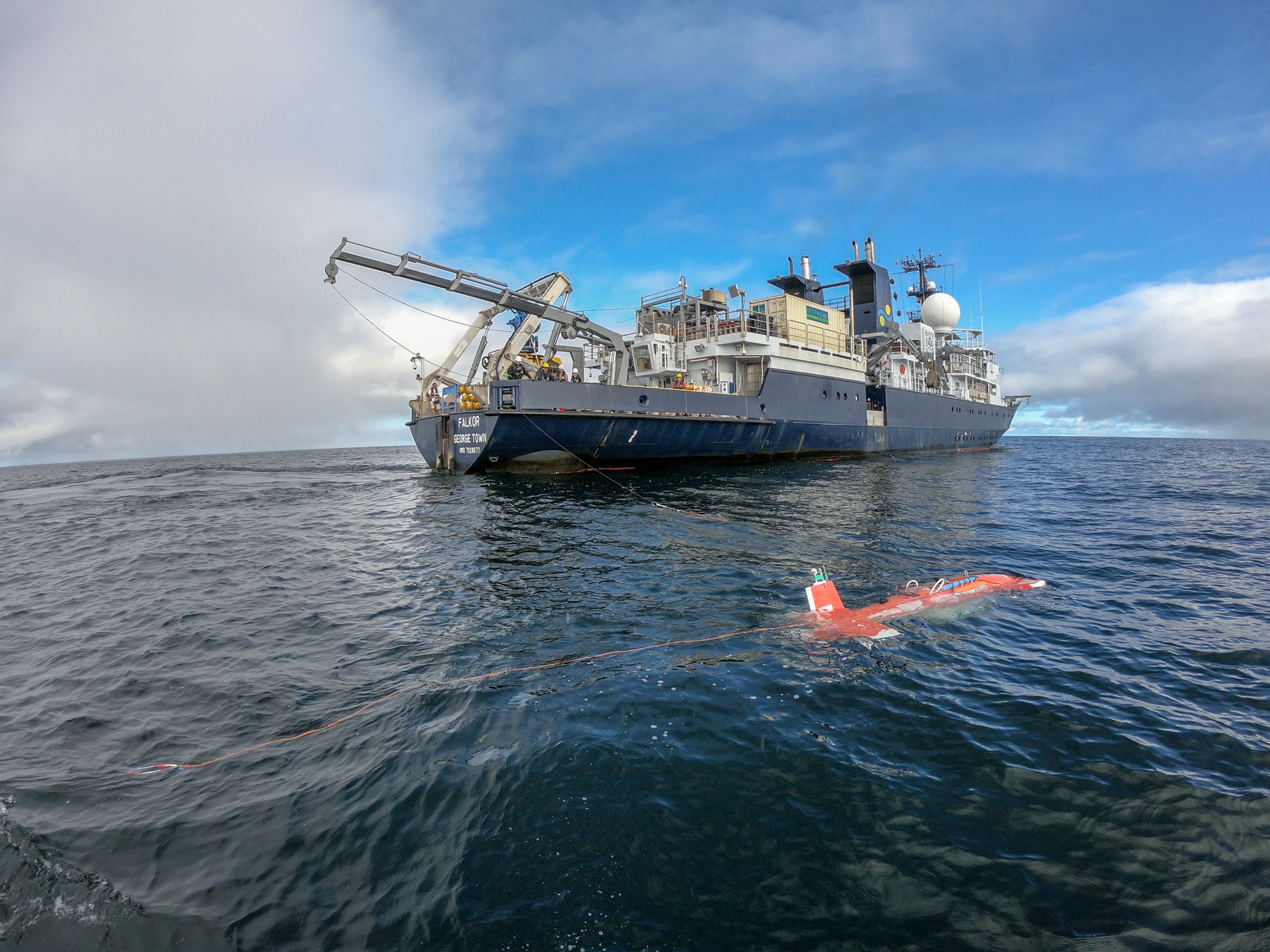
Most underwater robots are now unmanned. These can be broadly split into 3 categories. Remotely operated systems, that are teleoperated through a cable connecting the robot to a ship, autonomous robots that do not require a tether and actively propel themselves through the environment, and more passive robotic systems, that simply like to drift along on currents and can stay out in the ocean for several months/years.
What is the overall goal at Schmidt Ocean Institute? How far are you from meeting this goal?
Our goal is to combine advanced science with state-of-the-art technology to achieve lasting results in ocean research, to catalyze sharing of the information, and to communicate this knowledge to audiences around the world. We foster a deeper understanding of our environment. We try to achieve this on every mission that we select.
What is the importance of underwater robots?
They can gather information about the ocean that cannot be gathered in any other way, and do so without putting humans in risky situations.
What precautions are being taken to make sure ocean life is safe with the use of underwater robotics?
The underwater robots are extremely delicate and expensive pieces of kit, and so we design them to make every effort possible to avoid any form of obstacle, including and animals. Besides that, the people who build them also care about the animals and make sure our robots won’t harm anything!
Why is underwater robotics becoming increasingly popular now?
Underwater robotics research for science has a history of more than 50 years. Low-power, compact computers and high energy-density batteries is making the field much more accessible for engineers, but is also making the robots much more useful for scientists. The combination of these 2 things is what is accelerating the advance in technology.
What kinds of cruises does Schmidt Ocean Institute have coming up later this year?
We have several exciting expeditions planned for later this year, learn more about our 2018 cruise plan here: schmidtocean.org/cruises/schmidt-ocean-institute-2018-expeditionsWhat will your underwater robots be able to accomplish that previous underwater robotics ventures have not?
We are mapping extremely wide areas using underwater camera systems. This in itself is quite unique, but what makes this expedition very unique is that the imagery collected by one robot will be used to direct other robots to the most interesting places. Like a tour guide.
I believe one of the reasons the public connects with space more than underwater is visuals. Images from space are much more colorful and wonderous. What advancements in underwater site and imagery are being developed? What advancements would you like to see?
Well the colors seen in most of the space imagery are artist impressions, and these artists are really talented people. For underwater imagery, the area you can see in a single image is limited by how quickly light is absorbed by water, so researchers are working on ways to make big maps by stitching together many thousands of these images. I would like to see these images being turned into human insight. There is a saying that a picture speaks a thousand words, but our challenge is to turn many thousands of images into human understanding of the ocea
What procedures are followed to ensure that the R/V Falkor is not damaged?
The R/V Falkor has an incredible experienced and disciplined crew, keeping the ship safe is the number one priority for everyone involved. All our activities are planned ahead of time and we have daily meetings to identify potential risks and pathways to mitigate these.
What are the steps someone should take to become a marine technician?
Currently there’s no set path to become Marine Technician. Veit, one of the MTs onboard first studied Geology, then he joined a ship and began gathering useful knowledge until he became a Marine Technician. Paul, the Lead MT, first started with an electronics degree and then joined a ship. Kaarel, another MT, started as a deckhand while he was studying neurosciences. They advise to get a degree in sciences or IT and find apprenticeships as a ship engineer or marine technician. If the person is in the US, they can also look into a MATE (Marine Advance Tech Education) Internship. We also have more information about careers ore on our Careers At Sea webpageHow can using underwater robotics help us learn more about climate change?
Underwater robots can directly measure things like greenhouse gas concentration over wide areas and at high resolutions. However, I think the main advantage they offer is the ability to act as the eyes and ears of the science community, and help us understand the different processes that have a contribution.