




Multibeam Mapping
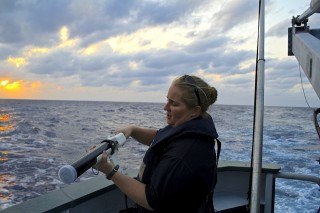
Falkor is continuing its journey up through the waters of the Papahānaumokuākea Marine National Monument. We are presently off Lisianski Island, our farthest point from Honolulu on this second cruise, and today I thought it would be helpful to explain a little bit more about how the mapping process works.
To do the mapping well, we have to pay careful attention to the multibeam monitors at all times, even at night and through the wee hours of the morning. We also have to process the multibeam data onboard as soon as they are created, so that we can get mapping products out to interested parties shortly after our time on the Falkor comes to an end.
Collection of Pings
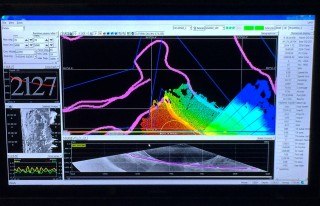
Falkor’s advanced Kongsberg multibeam sonars
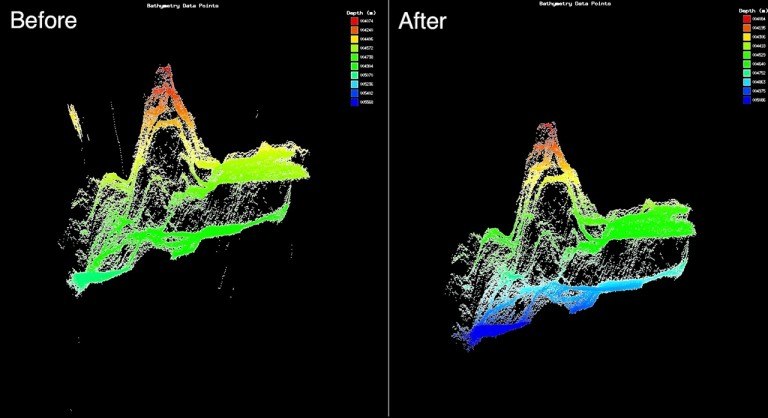
After our data are collected, we inspect them to ensure they don’t contain false depth calculations from pings that went astray. This sometimes occurs from interference, such as pings bouncing off fish or whales, or from rough seas. We ‘clean’ our bathymetry data by removing, or invalidating, bad pings. The figure to the right shows a before and after view to give you an idea of what’s involved. We call this process “killing dots”, and we’ve been doing this mainly using a program called “Saber”. Luckily, the placement and sophistication of the Falkor sonars are so good that we generally don’t need to kill too many dots.
Uncovering the Seafloor
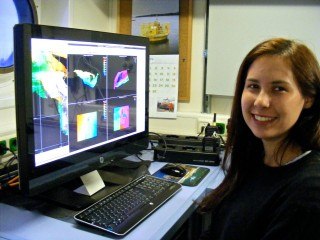
To discover the full extent of all the features we’re currently mapping in the monument, we have combined our data with those previously collected on the first cruise as well as older cruises dating back to 2002. We also use Saber to perform this synthesis using what’s called a Pure File Magic (PFM). Once our data are incorporated into the PFM, we perform a second check to make sure the older cruise data and our new Falkor data blend correctly together to make a coherent image.
Unfortunately, the multibeam data from some of the older cruises aren’t as high quality as our new data, so we end up spending many long hours each day editing the datasets. However, when it’s done and we take a look at the wonderful images we have created, we realize that all of this work and the very long late nights have been worth it.