
On ROV SuBastian's Dive S93
Dripping Pillows
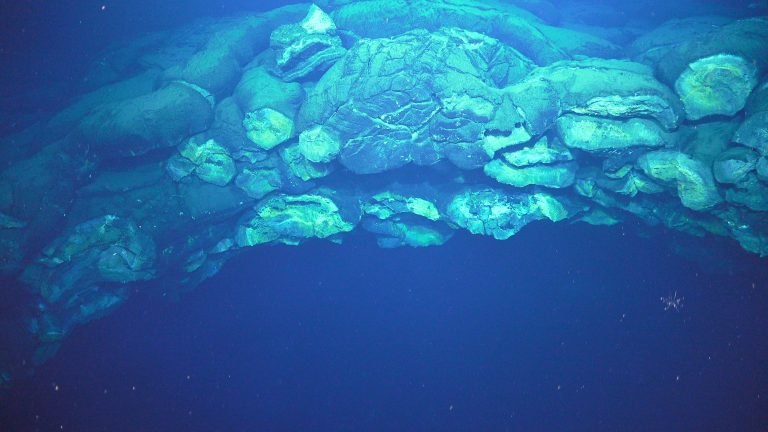
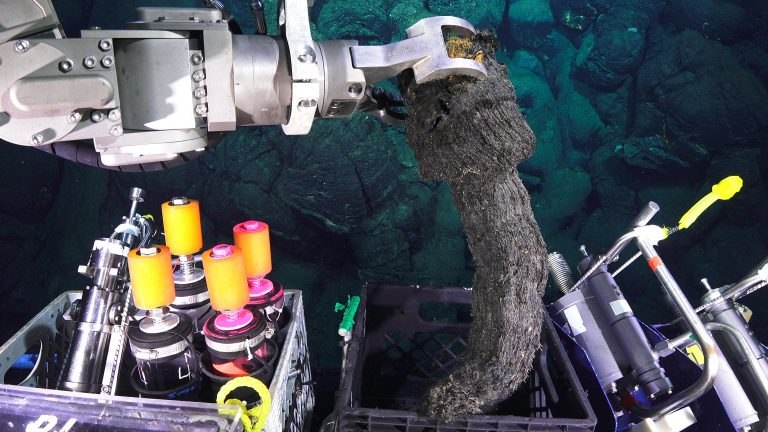
We approached the ridge from downslope and found that it had a wide apron of thin pillow lava flows downslope from the steep-side, haystack shaped mounds.The thin flows on the margin also seemed to have more ash deposited on them than the lavas at the top of the pillow mounds.We think that reflects a sequence of events, with the eruption starting with an explosive phase, followed by thin pillow flows that were emplaced when the eruption rate was a bit higher (so they could spread out faster and thinner), followed by the construction of the steep-sided mounds directly over the eruptive fissure at a lower eruption rate (so the lava solidified and piled up closer to the vent).As the ROV climbed up the nearly-vertical sides of the steep pillow mounds, we saw long pillow lava tubes that looked like drips of wax on the sides of a candle. We were able to sample one of those pillow lava drips.
Craters & Scaleworms
Two of the shallowest pillow mounds along the ridge have craters in the tops, and ROV SuBastian was able to go down inside them to have a look around.One had an overhanging rim, and on the inside wall we could see a cross-section of the inside of the mound, consisting of layer upon layer of truncated pillows.These collapse craters confirm that the interior of many pillow mounds like these have molten interiors as they grow upwards and outwards.
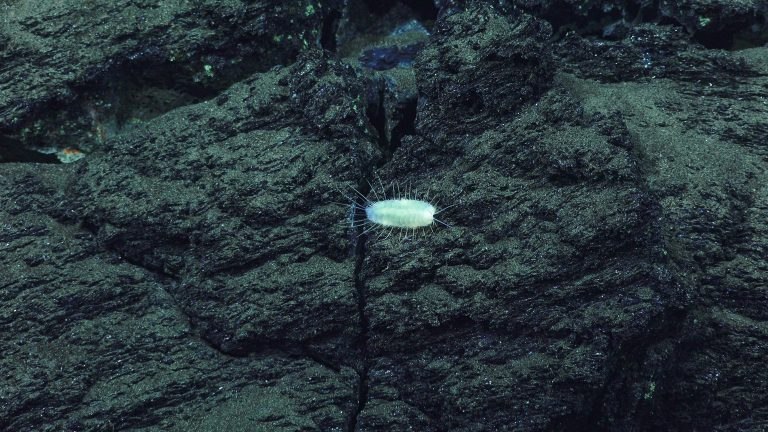
Throughout the dive we saw many white scaleworms that are a species that live only at hydrothermal vents, swimming above the seafloor or sitting on the rocks.We did not see any active hydrothermal venting, but the presence of the scaleworms (and occasional cloudy water) shows that this recent eruption site is still a little warm and must still have a little venting coming out, at least locally. It is amazing to see how well adapted hydrothermal vent animals are and that they can find these new eruption sites, colonizing them quickly, even though the venting is destined to only last a few years.On the other hand, West Mata is so active, it will not be long until the next eruption!