
Falkor will spend sixteen very intense days mapping and exploring seven of the Emperor Seamounts, an ambitious goal that requires covering a long distance over the ocean simply to get to the first destination. Just about halfway, there will be a quick stop at Hess Rise2: Seamounts are clusters of life.
There is a reason why ROV SuBastian is visiting seamounts so often. Seamounts are very important underwater geological structures that gather a concentration of deep-sea life. When water currents come across a seamount, they are forced to go around (or over) it to continue their course. The higher flux of water concentrates nutrients, which is very attractive for marine life to consume. Depending on their depth, seamounts are known as "aggregating devices" for fish, which is why many times they will be the focus of deep-sea trawling and fisheries. The acceleration of currents will also create a "wind sweep" effect, preventing sediments from accumulating and providing corals with the kind of hard substrate that enables them to colonize and expand. Given the fact that corals are ecosystem engineers, where the corals form, a suite of deep-sea life will follow.
3: This expedition is full of first times for crew, researchers, and science.
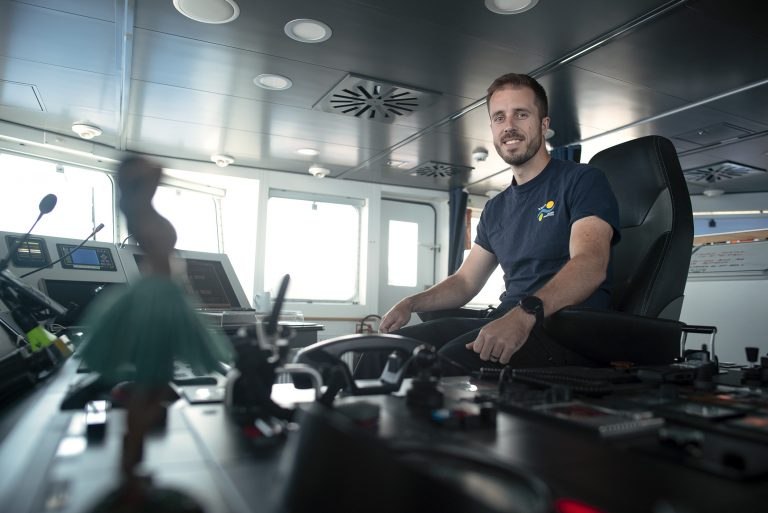
There are many reasons why this research cruise is going to be special. One is the fact that it will have many first's. One example is that this will be the first expedition for Jason Garwood as Captain. "It is a new challenge for me, a new position, and I'm enjoying it very much," he shares. "It is a ship I trust, and more importantly, a crew I trust."
Jason Garwood has years of experience as a seafarer and onboard Falkor, yet this is his first expedition as Captain.[/caption]
New experiences are also in store for the ROV team. This will be the first time that Jason Rodriguez4: No Tech, No Seamount (or "Know Tech, Know Seamount")
Everything we know about these seamounts has come from indirect observations that technology has made possible. The scientists have been able to identify the different communities that inhabit the area based on samples collected through deep-sea trawling. They are also aware of the very presence of the seamounts themselves because of satellite altimetry, which provides a rough estimate of the size and shape of the structures. Today, technology will enable the experts to test their hypothesis and study the seafloor in ways that are not only exponentially more precise, but much less invasive. ROV SuBastian avoids any collisions or interactions that impact the ecosystem and will take only the samples that are absolutely necessary. The vehicle's cameras and lights permit detailed observations that would have been impossible just a few years ago. By identifying environmental DNA,