




Melissa Omand, interdisciplinary physical oceanographer from the University of Rhode Island’s Graduate School of Oceanography
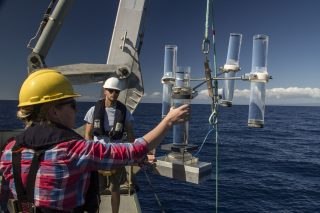
Melissa Omand deploys the sediment traps as part of the Wirewalker, while Oliver Hurdwell observes closely.[/caption]
Upcycling
Melissa and Noah are working with two different novel instruments in this cruise. The first one is a time-lapse camera developed after repurposing her previous mobile. The phone will dangle at the base of a 150 meter wire, deployed as part of the Wirewalker assembly. For three or four days, the camera snaps pictures of the base of a sediment trap which collects falling particles called marine snow
Stepping in
A second novel instrument Melissa has brought on board is a holographic camera. Unlike traditional photography, a holographic image is obtained when a laser beam hits an object and either bounces off of it or goes through it, bending the light. More a computer than just a camera, the instrument combines diffraction data with math in order to reconstruct the light's journey after interacting with the object (in this case, a planktonic organism). Tracing the behaviour of the light provides an enormous amount of information about the object's characteristics in three dimensions. The result is an image that allows the experts to focus on different planes, and not in just one single depth of field.
This is interesting both because it vastly increases the volume sampled by enabling the scientists to choose where to focus on a picture that has already been taken, and in that it enables a very exciting application: Virtual Reality