




Act 1: Blowin’ in the wind
At the unholy hour of 0400, I find myself on the aft deck of the world-class research vessel Falkor, bubbling with excitement stemming from a unique combination of four shots of espresso, generally being a morning person, and, most importantly, preparing to test an experimental device that I have put my blood, sweat, and tears into. As I bear-hug my newly collected bucket full of seawater on the rocking transit back to the wet lab, I take a moment to silently congratulate myself on the superb display of stamina and posture; it appears that my sea legs have finally decided to make an appearance. The sun will be coming up soon. It’s a Bob Dylan kind of day. Time to turn up the music and get to work.

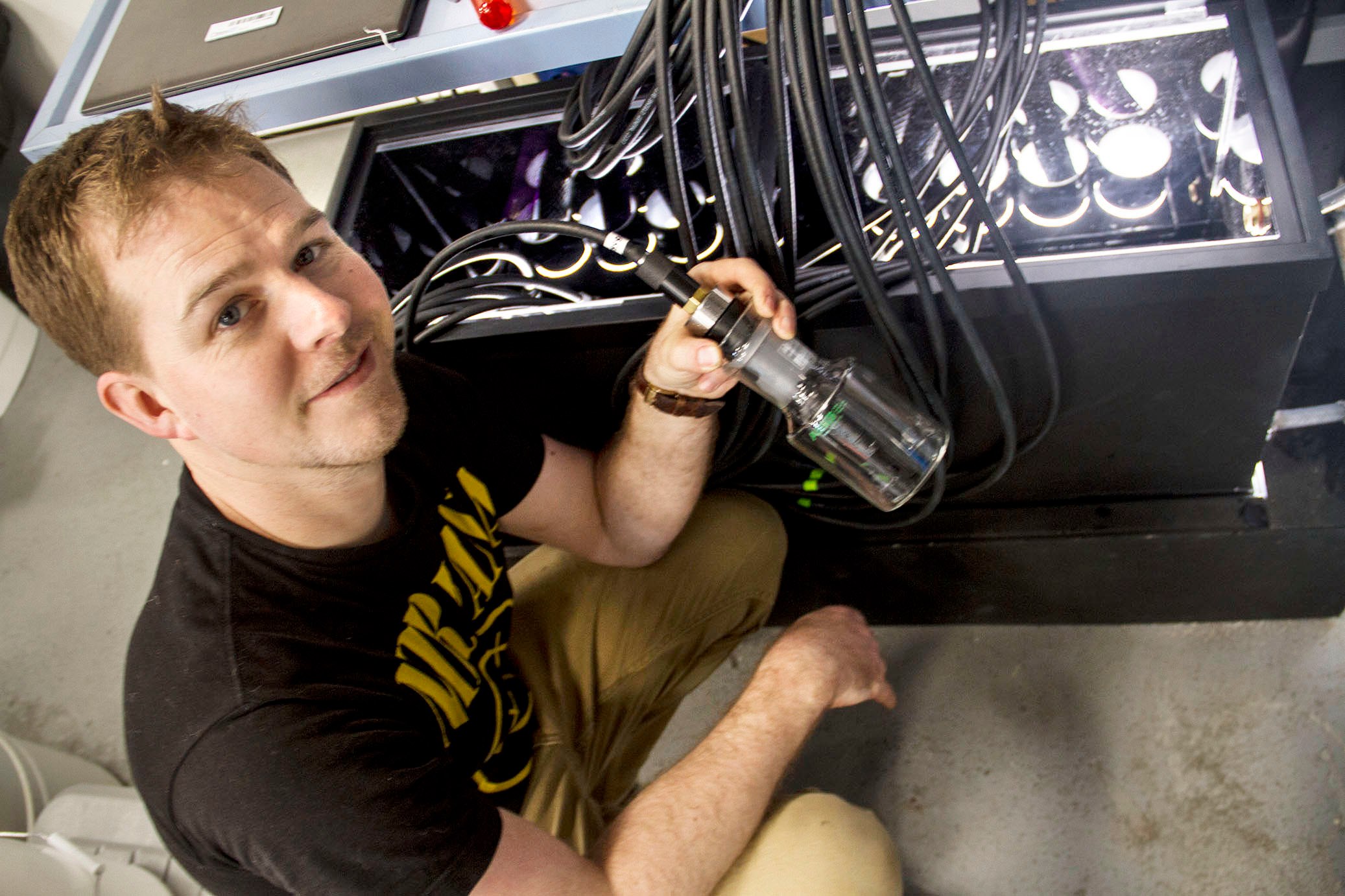
Ryan Vandermeulen, optical oceanographer, is testing this instrument at sea for the first time. The experimental “photosynthetron” (a.k.a. electro-squid 4000) serves as an incubation chamber for seawater samples.[/caption]
Act 2: There ain’t no party like a plankton party
In addition to being an eclectic lab DJ, one of my roles as a scientist aboard this righteously amazing research vessel is to investigate the rates of biological activity among microscopic communities within the ocean. The invitees to this epic microbial festival include bacteria, viruses, zooplankton, larval fish, and phytoplankton (algae). The photosynthetic members of this microscopic plankton community (PHYTO-plankton) are the base of a complex ocean food web, and have a large cascading ecological impact on the abundance and diversity of fisheries that we depend on. In addition, phytoplankton play a significant role in the global cycling of carbon, as well as the production of oxygen we breathe. Just like the plants in your garden, phytoplankton utilize carbon dioxide and micronutrients in the seawater - along with various light harvesting pigments which capture sunlight at different wavelengths - to create new cell bodies.
A byproduct of this magnificent life-giving process of photosynthesis is the production of oxygen, which we measure with great precision as a proxy for the amount of carbon that has been fixed into organic matter. The remaining (non-photosynthetic) members of this microbial party are not particularly polite dinner guests and have a tendency to exploit the kindness of our fearless photosynthetic community by eating the food that the phytoplankton have dutifully prepared, namely themselves (phytoplankton bodies) along with their subsequent secretion of dissolved organic matter (zooplankton are quite the sloppy eaters). We measure this microscopic massacre in the form of oxygen consumption, because, like us, these microbial heterotrophs need oxygen and organic matter that phytoplankton produce in order to live. Collectively, the ocean acts as one breathing organism as this process plays out, silently taking in copious amounts of carbon dioxide from the atmosphere and giving us oxygen that we breathe. This balance (or lack thereof) of carbon/oxygen uptake versus production lends us insight into the overall health or metabolic status of an ecosystem, in a way similar to taking the pulse of your body.
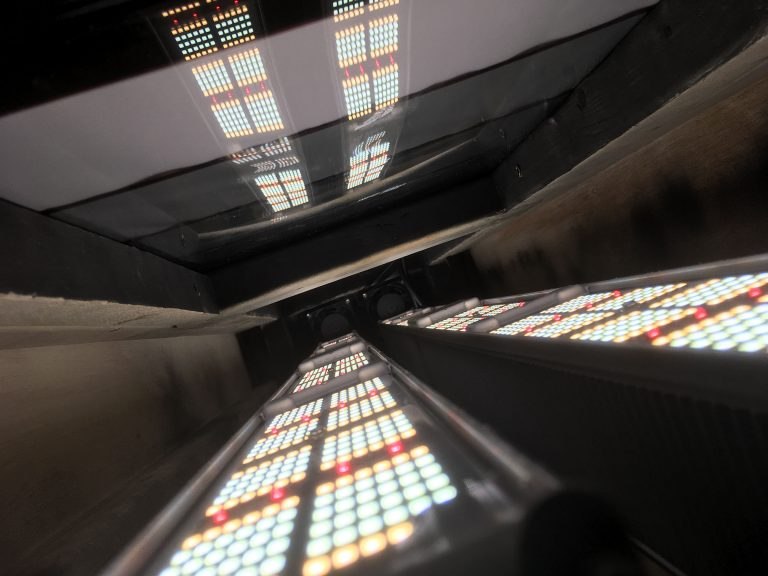
The Various light levels of the photosynthetron simulate different light conditions through the day, and the subsequent oxygen production/consumption is measured using optical sensors.[/caption]
Act 3: Some telescopic insights into microscopic processes
Act 4: Some microscopic insights into life, the universe, and everything
It’s been a long day, so I am going to wind down, grab my guitar, and serenade the sunset. They say if you sing to plants, they grow better, so there is some scientific merit to this ritual, mind you. Incidentally, our artist-at-sea, Kirsten, has inspired me through one of her onboard art + science seminars to try and take a more careful and purposeful look at the world around me. I will temporarily suspend the thought of Rayleigh scattering and radiative transfer equations as I watch the sun’s rays extend across the horizon. For now, I’ll just listen and observe.