



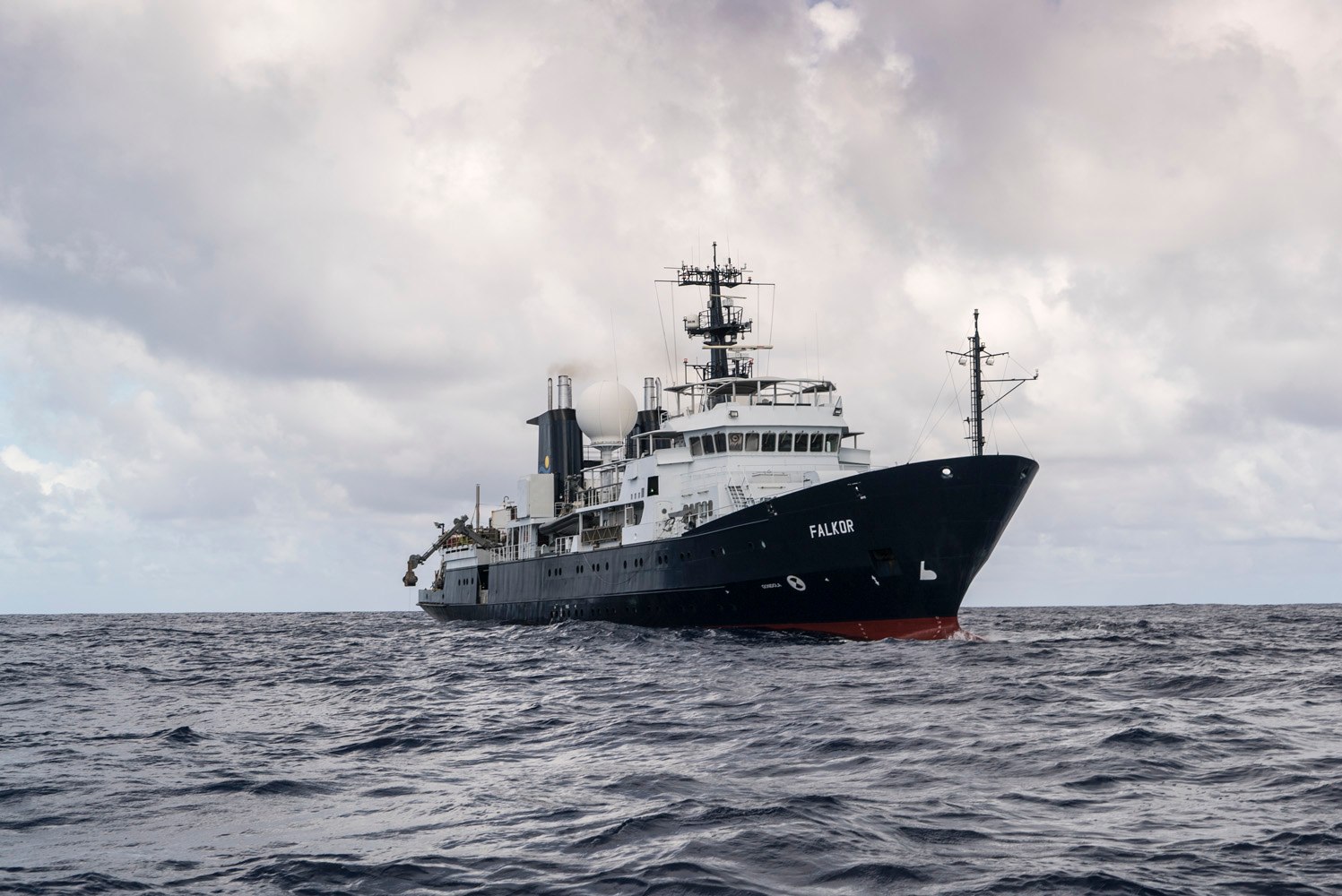

The swell seems invisible, but is clearly revealed by Falkor’s rocking and rolling. It represents no challenge for the experienced crew and by the end of the day, ROV SuBastian is safely back on the aft deck after twelve hours of exploring the sea bottom. While the cloudscape glows a beautiful purple and orange tint, a less appealing sulphuric smell fills the corridors leading to the Wet Lab: the water samples come full of volcanic scents.
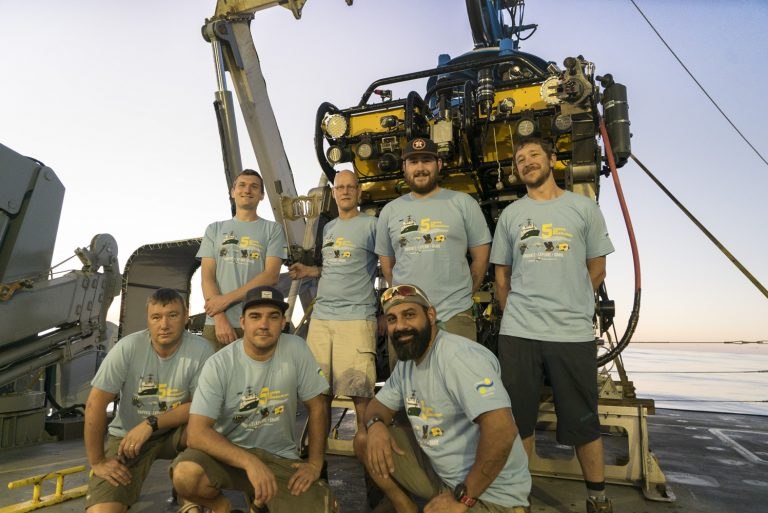
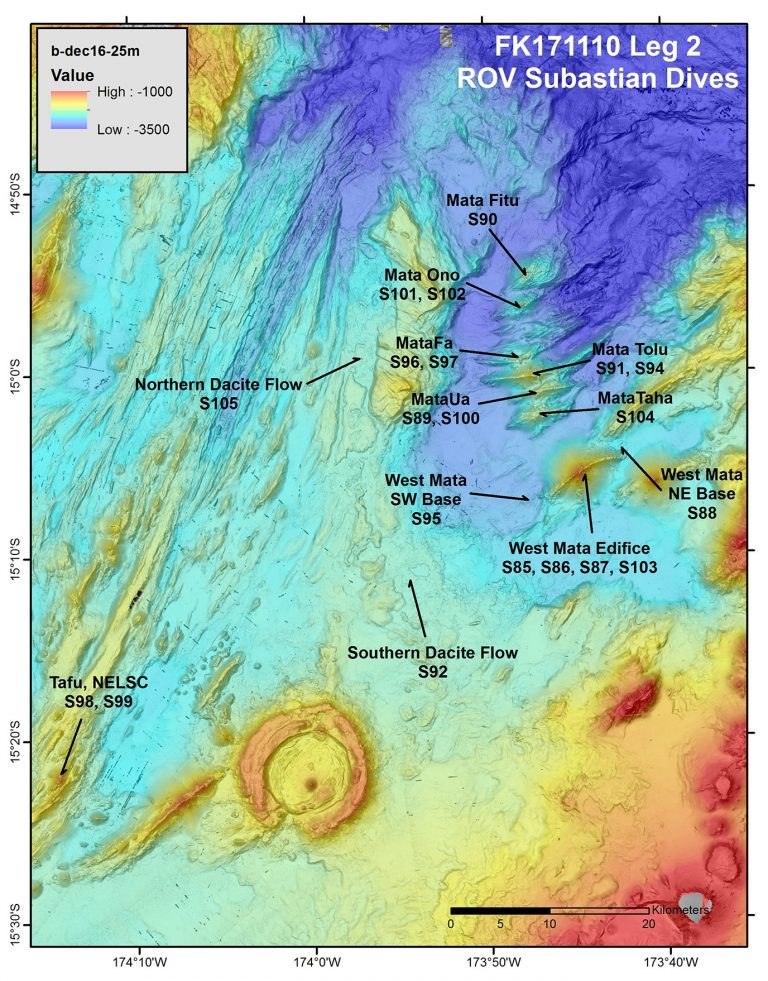
Twenty-one ROV dives have provided the on-board multidisciplinary team of experts with bountiful data about these young submarine volcanoes and their recent eruptions, plus their impacts on the ocean. The aim of this research group is to understand the geological, biological, and chemical processes at these seamounts, in a chronological context. By studying the geological and magmatic evolution of each volcano in particular - and of all of them as a group - the scientists are developing a stronger understanding of their volcanic history, how and when they formed and grew, as well as their levels of activity. That motivation, and the relationship to magma generation across a wide array of volcanic sites was the core of this expedition, explains the team’s fixation with rocks, having collected over 350 of them. Vent biology, fluid chemistry, and chimney sampling were also components of the research, clarifying the relationships between volcano history and settings, with the development of hydrothermal systems and hydrothermal ecosystems
The Stage
The northern waters of the Kingdom of Tonga in the NorthEast Lau Basin are some of the most tectonically and volcanically active parts of the planet. There is a high density of active submarine volcanoes in a very small area, including the Mata Volcano Group. Here, the volcanoes erupt several unusual types of magma, including a very hot and rarely observed type known as boninite
Piecing It Together
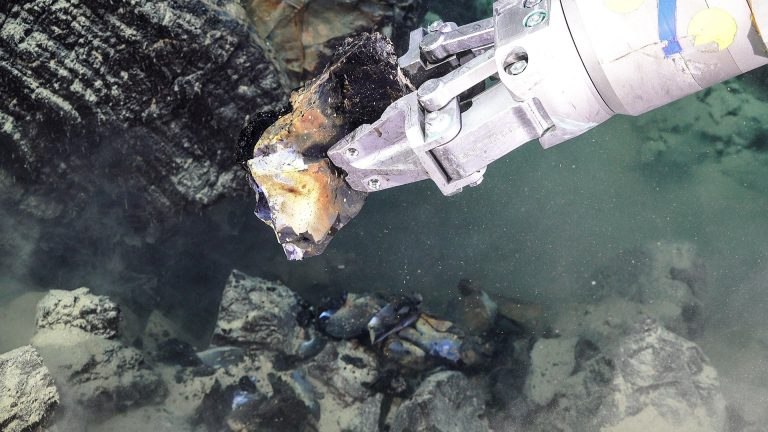
Each time the team deployed SuBastian to look at the rocky outcrops on the seabed, they did so to observe an extensive spatial range of eruption deposits and gain a deeper understanding of how they are distributed across time in a particular location. In order to do so, the team would identify pieces of material that were representative of the phenomena that they are trying to describe. Each specimen was examined before being collected by the manipulator arms of the ROV. The samples need to be a manageable size, well-preserved, and - in the case of volcanic rocks - glassy: since glass is a material that freezes very quickly on the exterior of a submarine lava flow and it preserves the chemical composition in higher fidelity than the interior of the rock, this is an important characteristic.
“The field work is just the first part when we collect samples of volcanic material. The real work continues back in the lab. We take rocks apart both chemically and physically, in a process designed to tell us what is the chemical composition of the rock, how did it form, and how did it come to be what it is. This will take months to years,” shares Dr. Ken Rubin, Chief Scientist.
Some Highlights
This unique geological setting causes a wide diversity of rock types, some among the rarest on our planet. For instance, until recentlyexperts had only found ancient specimens of boninite. It is a very hot, unusual type of lava, only found in subduction zones. In this region many of the volcanoes erupt exclusively boninite lava.
The team was able to closely observe large flows of a different kind of lava: dacite
A key observation was that even though these volcanoes are very closely-spaced (2 km apart in average), the differences between them are stark. Four of them have hydrothermal systems, yet the style of the hydrothermalism - the shapes and spacing of the chimneys, their height, and the biological communities living on them - is very different from site to site. When it comes to the Mata Volcanoes, West Mata stands out as different from the rest. Because of its recent eruptions, the chemistry of the water around it is completely different from that of a typical high temperature black smoker system. The rest of the Matas exhibit a more common high temperature system, yet there are still many things left to understand. For Instance: “We are really still trying to piece together what the rules are that determine which animals live in each different site. Chemistry has something to do with it for sure, but just looking at the North Matas, we see differences between the animal communities from one site to another - yet the chemistry is really quite similar,” says Dr. David Butterfield, Chemical Oceanographer. Biological interactions, competition, and first colonization are all factors that could also play a role.
21 ROV dives at 11 submarine volcanoes, 350+ Rock samples, 30+ Sulphide samples, 60+ Vent fluid samples, 470+ Biological samples, 12,000+ km2 of seafloor mapped. The amount of data collected during the Underwater Fire expedition is sure to keep the scientists and their teams busy for a long time to come.