



I have been utterly captivated by the ocean from a young age, swimming, diving, and watching every single nature documentary I could get my hands on. Yet, my infatuation with coral only started a few years back—but boy, oh boy, ever since then, I have been dedicating all my time to learning more about it. As an honours student on the brink of a research career, I have a burning desire to contribute to coral research, especially in such a critical time when coral reefs worldwide are declining at unprecedented rates due to climate change. Hence, when my university supervisor said there might be an opportunity to help collect coral/eDNA samples on the R/V Falkor, I could barely hold the excitement.
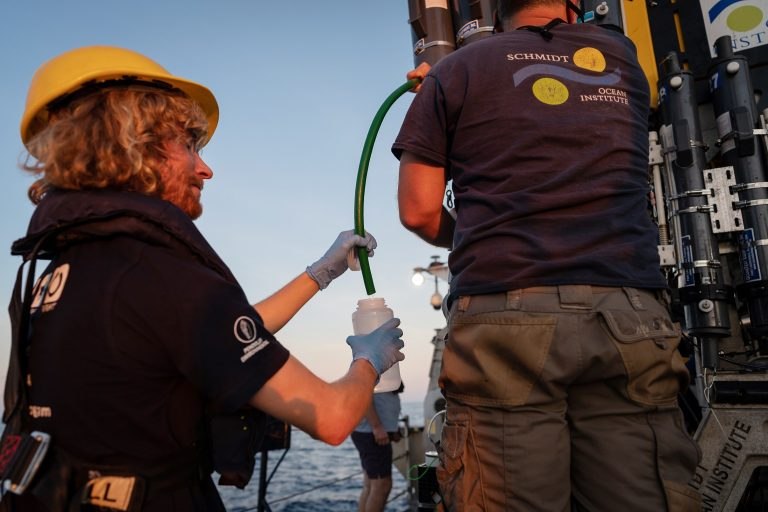
I have been tasked with collecting environmental DNA (eDNA)
eDNA techniques are being employed at Ashmore reef to understand the breadth of diversity present in these unexplored waters. Although eDNA collection is a relatively new method of surveying, it has enormous potential in biological monitoring. Conventional methods for surveying biodiversity can cause disturbance or destruction of habitat and may rely on methods in which it is difficult to detect small or elusive species. eDNA methods offer a less invasive way of measuring species abundance and richness and sample greater diversity with increased taxonomic resolution. These methods can also correctly identify species with morphological complexities, cryptic life stages, and species that are invasive to the area.
To compare the diversity present at Ashmore reef, SuBastian, our friendly submarine will fill 9 Niskins full of water from 3 different depths (50 m, 100 m, and 150 m) across 7 reef locations. This will allow direct comparisons of biodiversity and species abundance between the different depths. Once SuBastian is back on deck, I vacuum-filter 1L of water from each Niskin using Nalgene 250-mL filter funnels, accumulating the eDNA onto an MF-Millipore 0.45 µm membrane that is rolled up into a cryotube for storage. These samples are then kept at a chilly -80°C until they are shipped back to the Australian Institute of Marine Science
I have only been at sea for a few days now, and already I have learnt so much from the fantastic team of researchers on board. We also have, it seems, gone mad, randomly generating pirate names for the entire science team. This might be a symptom of the salty air, or possibly the long hours in the lab, which I now call ‘Declan’s Dungeon’. I expect I shall be spending a lot of time in my little lab under the stairs. But I can not wait to get stuck into some coral science. I mean, that’s why I am here! Hopefully, by the end of the trip, I will emerge from my dungeon a pro in eDNA processing—like a caterpillar blossoming into a butterfly. I hope that similarly, a green-horned honours student can emerge as an impassioned researcher.