




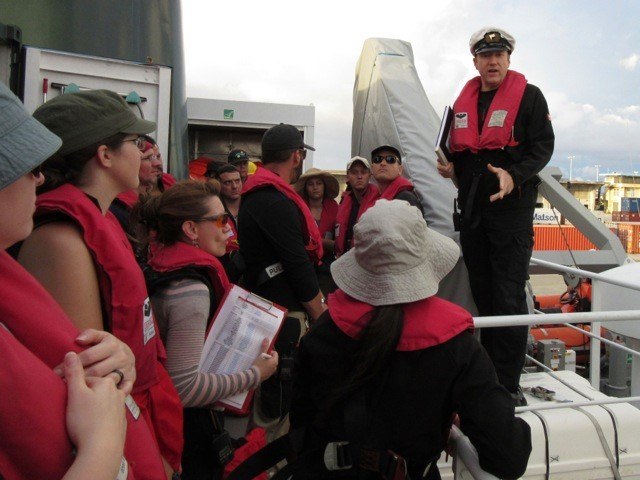
I am possibly the luckiest high school marine biology teacher on the planet. Here I am headed to the Sirena Deep with some of the most brilliant deep-sea scholars in the world.

If you have not read the Team Bios
Dr. Drazen gave us an introduction to the incredible biology of the deep sea on day one of this expedition and on day two, Dr. Fryer explained the complexities of the geology of the area. Both the science team and the Falkor crew spent the inital days preparing and testing equipment for the expedition. We anchored for a day in Apra Harbor, Guam to do shallow-water deployments of the rock grabber and the core respirometer (more on this equipment in future blogs). It was a very long and successful day.
Going Deeper
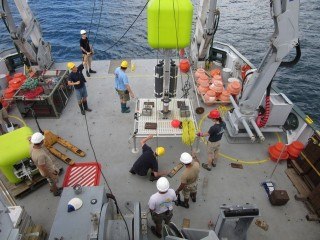
This morning (day three) we set sail to the Sirena Deep, our targeted spot in the Mariana Trench. We are beginning our explorations on the non-subducting Mariana Microplate at a depth of about 5000 meters (three miles). We deployed the core respirometer, the fish trap, two camera systems (the abyssal lander and the hadal lander), and the rock grabber. The core respirometer will stay on the sea floor for two days as it measures oxygen consumption in cores of sediment. While waiting for the respirometer, the other landers will surface and be redeployed. The fish trap is baited with mackerel on the inside and has hooks baited with squid on the outside. It is much larger than you would expect. The two camera systems also use fish as bait to attract organisms. The hadal lander has forward facing cameras while the abyssal lander’s camera faces the bottom. The hadal lander also has baited traps to catch amphipods. The rock grabber has two sets of jaws that grab sand, sediment or rock when it hits bottom.

Deployment is fun, but the real excitement comes when the landers return to the surface. We will continue with deployments going deeper and deeper until we reach the bottom of the Sirena Deep. We will then head up the subducting side of the Trench on the Pacific Plate, continuing to deploy the landers. Deep-sea studies are challenging, but the rewards are magnificent.