



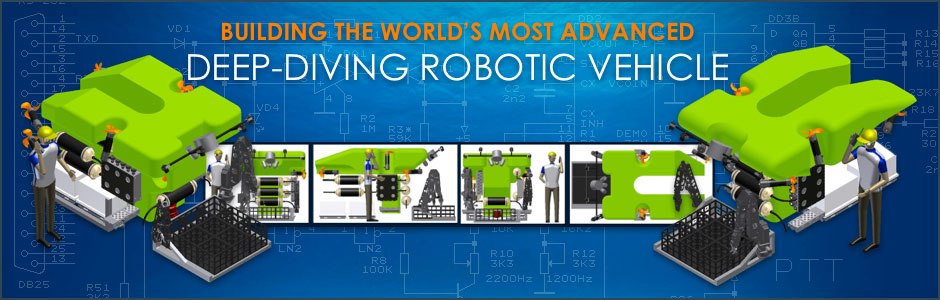

Schmidt Ocean Institute has successfully completed preliminary designs that will be leveraged for the development of a full ocean depth robotic research vehicle. Staged vehicle construction is scheduled to begin this year.
Schmidt Ocean Institute persistently seeks to advance ocean research through the use of cutting edge technologies and infrastructure, and the full ocean depth Hybrid Remotely Operated Vehicle (HROV) program is a great example of these efforts. HROV program will proceed iteratively, producing a series of vehicles with gradually advancing depth and research capabilities for exclusive use on research vessel Falkor. Schmidt Ocean Institute plans to develop three vehicles at annual increments. The first vehicle with 4500m depth rating is expected to be built and ready for testing in April 2016. Schmidt Ocean Institute will manage the HROV program including the vehicle design and build in a dedicated research and development facility in the San Francisco Bay Area. The project team will consist of SOI engineers, collaborators, and subcontractors who will focus on different component and subsystems of the new vehicle. “Through a productive collaboration with Woods Hole Oceanographic Institution last year, we have set the stage for the development of some of the most advanced research robots for the deep ocean”, said Victor Zykov, Schmidt Ocean Institute Director of Research. Zykov announced earlier this week that, “the successful completion of the preliminary design and initiation of vehicle development re-affirms Schmidt Ocean Institute’s commitment to advancing ocean sciences with innovative technologies.”
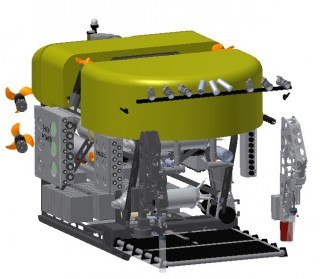
The vehicle development path will include design and construction of three distinct ROVs thereby creating a unique fleet. As designers optimize each new ROV, they will draw on lessons learned from previous vehicles and use the latest technology, creating more efficient, lighter vehicles. The first vehicle will be tentatively rated for 4500m, followed by a 7500 m HROV, and culminating in the delivery of a full ocean depth (11,000 m) capable HROV. Schmidt Ocean Institute HROV Program Manager David Wotherspoon spoke to the project plans, “…the project's repeat structuring will allow for greater learning experiences and is more likely to succeed. The knowledge of operating the first ROV will provide input into the concurrent build of the second, more capable vehicle, and the design of the third full ocean depth HROV.” After testing, each vehicle will be integrated into Schmidt Ocean Institute’s 272-foot research vessel Falkor. “As the ROVs are integrated onto Falkor, they will greatly expand our ability to provide scientists with unprecedented access to the deep sectors of the ocean” said Eric King, Schmidt Ocean Institute Director of Marine Operations. The ship is dedicated to accomplishing Schmidt Ocean Institute’s mission to enable research that expands understanding of the world’s ocean using advanced technology, intelligent observation, and open sharing of information. Schmidt Ocean Institute is excited about the potential future in vehicle development. December 16, 2014
