


Dive In
About the Expedition
The deep sea hosts minerals that contain high quantities of elements that are valuable for human societies. Countries around the world are preparing to develop extractive practices for deep-sea minerals, and baseline biological data are needed to further assess the life that may dwell on or around minerals in different benthic environments. To examine the trade-offs associated with any potential mineral extraction, Drs. Lisa Levin, Paul Jensen, and Greg Rouse from Scripps and Kira Mizell from the US Geological Survey will venture to the Southern California Borderland (SCB) to investigate several sites where marine minerals are known or expected to occur and assess the biological communities living amongst the mineral substrates. The team's goal is to establish mineral and biological baselines, examine conditions that may influence biodiversity and inspect the therapeutic potential of deep-sea microbes affiliated with mineral-rich areas. The knowledge gained from this expedition will inform policy, management, and stewardship of the deep sea off southern California.
- Dive Markers
- Trackline
The Mission
Establishing Baselines in the SCB
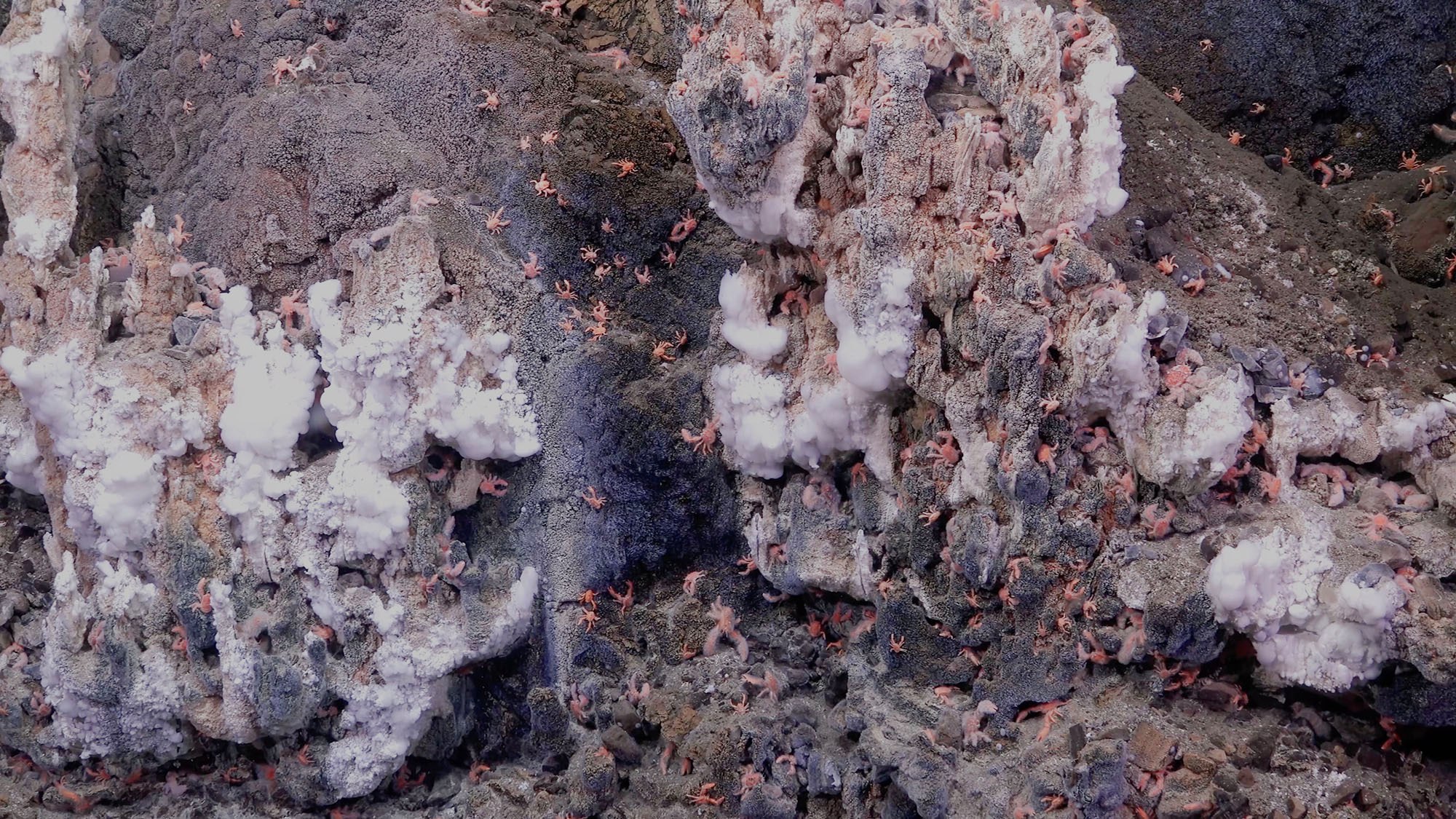
The Southern California Borderland (SCB) is a tectonically complicated, rugged, and heavily sedimented region of the California continental shelf that lies offshore between Los Angeles and the Mexico Border. Both ferromanganese (Fe-Mn) crusts and phosphorite marine mineral deposits occur in the SCB. Phosphorite has the potential to be a source of phosphorus for use in agricultural fertilizer, and both Fe-Mn crusts and phosphorites are enriched in rare metals that are used in electronics, green energy, and other technologies. These deep-sea resources are being considered elsewhere in the world for economic development.
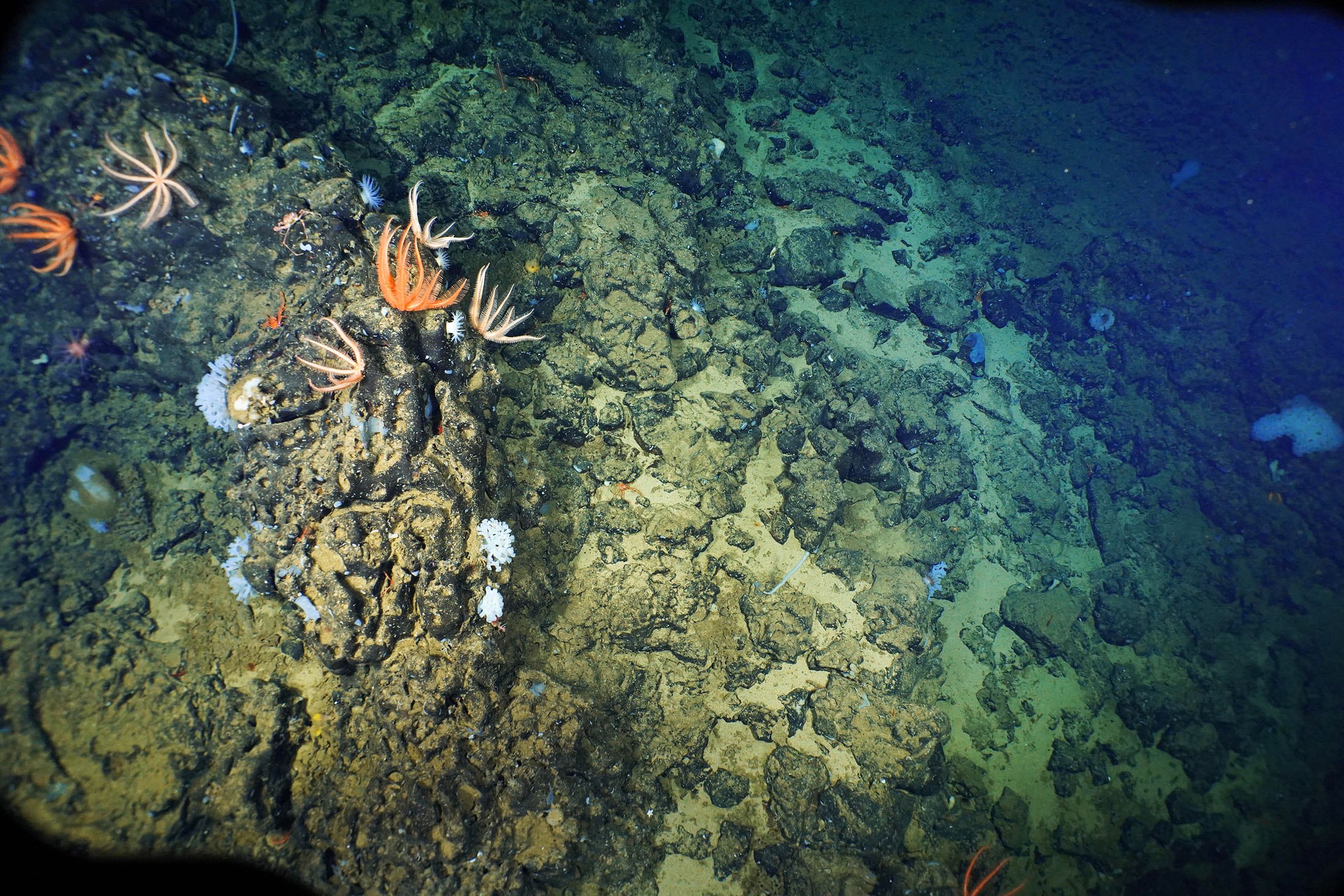
Dr. Lisa Levin and her collaborators will document minerals and affiliated species distribution in the SCB, enhancing knowledge of these systems and establishing biodiversity baselines. The team will also create protocols for assessing life in mineral-rich areas through examination of animals and microbes associated with varying benthic environments. By establishing these baselines, we may better understand the biodiversity tradeoffs involved in mineral removal in deep-sea environments and identify habitat features and assemblages that may be in need of conservation. In order to do this, the team will document environmental conditions and the variety of fauna based on factors such as water depth, rock type, oxygen availability, sedimentation, and proximity to shore. The team will utilize a variety of methods to document all shapes and sizes of life, like small invertebrates, deep-sea corals and sponges, demersal fish, and microbes.
A Multitude of Methods for Characterizing the SCB
Hardground habitats of the deep sea are hard to characterize, especially quantitatively. Most characterizations have been done via video for larger animals, but not for smaller animals and microbes, which requires sampling. Using ROV SuBastian, the team will selectively sample and quantify the small animals on rock substrates and in sediments, determine their relationship with microbes, and examine the associations of both biological groups with different geologic habitats. The simultaneous investigation of biology across multiple size scales, microbial characterization, and various geologic substrates are novel aspects of the study.
ROV SuBastian will collect targeted samples of rocks, invertebrates, and microbes to characterize biodiversity. Animals and microbes will also be preserved for DNA analysis to aid identification. The science team will additionally perform detailed analyses on microbial samples in order to categorize diversity and examine therapeutic and industrial potential. They will analyze bacteria collected from the water column, the sediment, rock samples, and invertebrates from each site. Microbial life in the deep sea is poorly studied, though initial estimates suggest the diversity is extensive and distinct from that observed in other habitats.
The team will also collect a series of colonization experiments deployed in 2020 at two depths with different oxygen concentrations of 700 and 1,100 meters. Invertebrate colonization of the rocks, wood, and bone will help expand understanding of animal affinities for different substrates in the deep sea - and whether specific minerals are critical to any specific species. Through this array of methods and analyses across different environments, Levin and her team will create a holistic picture of communities living amongst mineral-rich zones. They will address biodiversity as an ecosystem service, conservation imperatives, and examine if there are alternative values in areas associated with fish and future medicines.
DDT in the Deep
The expedition will spend one day at the DDT Barrel disposal site -collecting sediment cores for analysis of seafloor fauna and microbes in relation to the barrels to determine the accumulation and influence of DDT and its derivatives.
DDT was developed as an insecticide and commonly used in agriculture and households starting in the 1940s in the US until it was banned in 1972. Strong scientific evidence linked DDT as a cause of cancer in humans and pointed to DDT having a catastrophic impact on natural environments.
The information the team will collect on the DDT barrel disposal site will be compared to fauna and microbes on rock and core samples at comparable depths from the SCB region, in order to assess the impact of DDT on the deep sea.
Team and Collaborators



Explore
Updates from the Ship
All Ship Updates


Related Galleries
View AllWe are happy to offer a streamlined request process when usage falls within the parameters outlined in the Creative Commons Attribution-Noncommercial-ShareAlike 4.0 International (CC BY-NC-SA 4.0) License. However, due to our legal status as a 501(c)(3) private operating foundation, no media produced by Schmidt Ocean Institute may be used in attempting to influence legislation or lobbying.
Attribution-NonCommercial-ShareAlike | CC BY-NC-SA
Under this Creative Commons License, you are free to:
Share — copy and redistribute the material in any medium or format
Adapt — remix, transform, and build upon the material
Under the following terms:
Attribution. You must give appropriate credit, provide a link to the license, and indicate if changes were made. You may do so in any reasonable manner, but not in any way that suggests the licensor endorses you or your use.
NonCommercial. You may not use the material for commercial purposes.
ShareAlike. If you remix, transform, or build upon the material, you must distribute your contributions under the same license as the original.
Not sure this license fits your use? Head over to our Image Requests page to learn more
Divestreams
View all Divestreams

Weekly Videos
View all Weekly Videos
Discover More
Expedition Data
Title  | Type | Repository |
|---|---|---|
| Rock Samples | Rock Samples | Scripps Benthic Invertebrate Collection |
| Benthic Invertebrate | Biological Samples | Scripps Benthic Invertebrate Collection |
| Supplemental data including macrofauna counts, macrofauna taxonomy, and macrofauna comparisons | Biological Samples | UC San Diego |
| Voucher Specimens | Biological Samples | Scripps Benthic Invertebrate Collection |
| Macrofauna | Biological Samples | Other |
| Benthic macrofaunal data from colonization experiments | Biological Analysis Data | Ocean Biodiversity Information System (OBIS) |
| Vessel Underway Data | Oceanographic Property Data | Rolling Deck to Repository (R2R) |
| CTD, Event Logger, Navigation, and Imagery from ROV SuBastian | Captured Image/Video, Oceanographic Property Data, Navigation Data | Marine Geoscience Data System (MGDS) |
| 3D Models of Key Topological, Geological, and Biodiversity Regions from Video Transects | Other | YouTube |
| Water Geochemistry | Chemical Analysis Data, Water Samples | USGS |
Publications from This Expedition
30 Day Preliminary Cruise Report: Biodiverse Borderlands
Holland, N., Hiley, A., and Rouse, G. (2022). A new species of deep-sea torquaratorid enteropneust (Hemichordata): A sequential hermaphrodite with exceptionally wide lips. Invertebrate Biology, doi: 10.111/ivb.12379.
[This Article was published OPEN ACCESS]Vlach, D. (2023). An Illustrated Guide to the Southern California Borderland. California Digital Library, Retrieved from https://escholarship.org/uc/item/1hg7v0q0.
[This Article was published OPEN ACCESS]Wickstein, M. and Conway, K. (2023). The Chirostyloidea of the Northeastern Pacific: Host Associations, Range Extensions and a New Species (Decapoda: Anomura). Zootaxa, 5284 (1), doi:10.11646/zootaxa.5284.1.7.
Mongiardino Koch, N., Tilic, E., Miller, A.K., Stiller, J., and Rouse, G. (2023). Confusion will be my epitaph: genome-scale discordance stifles phylogenetic resolution of Holothuroidea. Proceedings of the Royal Society, 290, doi: 10.1098/rspb.2023.0988.
[This Article was published OPEN ACCESS]Guarieb, M., Mendoza, G., Mizell, K., Rouse, G., McCarthy, R., Pereira, O., and Levin, L. (2024). Deep-ocean macrofaunal assemblages on ferromanganese and phosphite-rich substrates in the Southern California Borderland. PeerJ, 12:e18290, doi: 10.7717/peerj.18290.
[This Article was published OPEN ACCESS]Stack, M., Richardot, W., Garcia, R., Nguyen, T., Anela Choy, C., Jensen, P., Gutleben, J., Dodder, N., Aluwihare, L., and Hoh, E. (2024). Identification of DDT+ in Deep Ocean Sediment and Biota in Southern California Bight. Env. Sci & Tech Letters, 11 (5), doi: 10.1021/acs.estlett.4c00115.
[This Article was published OPEN ACCESS]Neira, C., Mendoza, G., Bradley, A.., Gossett, R., Rouse, G., and Levin, L. (2024). Waste barrel contamination and macrobenthic communities in the San Pedro Basin DDT dumpsite. Marine Pollution Bulletin, 203, doi: 10.1016/j.marpolbul.2024.116463.
[This Article was published OPEN ACCESS]Turner, T., Rouse, G., Weigel, B., Janusson, C., Lemay, M., and Thacker, R. (2024). Taxonomy and phylogeny of the family Suberitidae (Porifera: Demospongiae) in California. Zootaxa, 5447(1), doi: 10.11646/zootaxa.5447.1.1.
Hugall, A., Byrne, M., and O'Hara, T. (2024). Genetic variation in the brooding brittle-star: a global hybrid polyploid complex? Royal Society Open Science, 11(8), doi: 10.1098/rsos.240428#d1e269.
[This Article was published OPEN ACCESS]Gutelban, J., Podell, S., Mizell, K., Sweeney, D., Neira, C., Levin, L, Jenson, P. (2025). Extremophile hotspots linked to containerized industrial waste dumping in the deep-sea basin. PNAS Nexus, 4(9), doi: 10.1093/pnasnexus/pgaf260.
[This Article was published OPEN ACCESS]Mandre, P., and Rouse, G. (2025). Molecular Phylogeny of the Deep-Sea Predatory Octacnemidae (Ascidiacea, Tunicata, Chordata), with Seven New Species. Diversity, 17(12), doi: 10.3390/d17120859.
[This Article was published OPEN ACCESS]Burkhardt, I., Bone, H., Grayson, N., Leucke, H., Jensen, P., Quattrini, A., Chase, A., and Moore, B. (2025). Diversification of diterpene biosynthesis occurred early in octocoral evolution. PNAS, 122(48), doi: 10.1073/pnas.2520279122.
[This Article was published OPEN ACCESS]Ullmann, A., Mendoza, G., Guraieb, M., Galindo, A., Flores Flores, X., and Levin, L. (2025). Wood shadows: The influence of Xylophaga on hard-substrate macrofauna in Southern California. Plos One, 20(12): e0337217. doi: 10.1371/jounral.pone.0337217.
[This Article was published OPEN ACCESS]Vlach, D., Pereira, O., Nguyen, F., Bradley, A., Mizell, K., and Levin, L. (2025). Megafaunal community structure on ferromanganese and phosphorite hardgrounds in the Southern California Borderland. DSR part II: Topical Studies in Oceanography, 224, doi: 10.1016/j.dsr2.2025.105560.
[This Article was published OPEN ACCESS]